

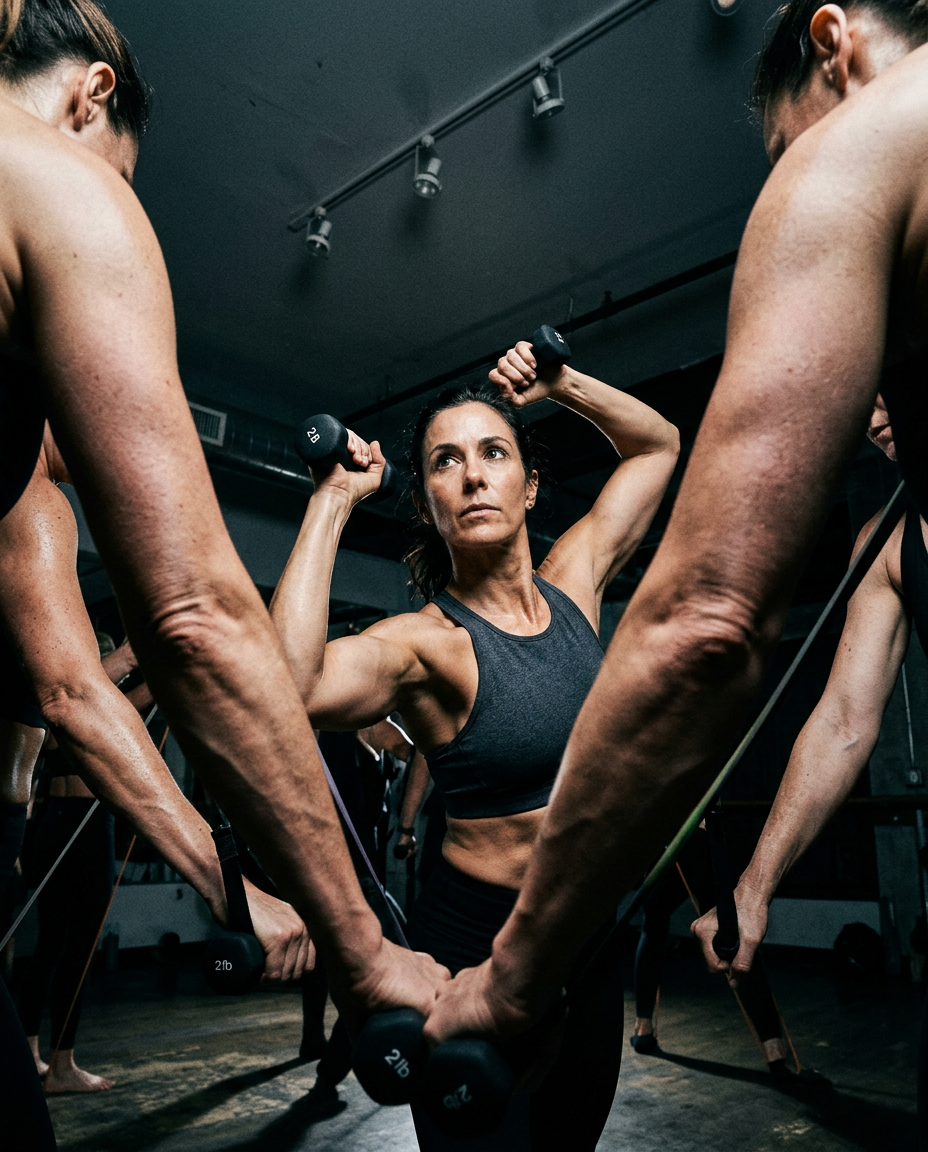


Welcome to the world of bodyweight training, the ultimate expression of functional fitness and the cornerstone of the Fullbody AI philosophy. This is your master guide to mastering the most versatile and accessible piece of equipment you will ever own - your own body. Whether you're taking your first steps into fitness or seeking superior relative strength, bodyweight training is a scalable and empowering path to your goals.
What "Bodyweight" actually means - clear definition + why it matters
Bodyweight training, also known as calisthenics, is a form of resistance training where the primary source of resistance is your own body weight. Instead of lifting a dumbbell, you are lifting, pushing, or pulling yourself against the force of gravity. This isn't just a convenient substitute for the gym-it's a discipline that develops a specific and highly valuable quality - relative strength.
Relative strength is your strength in relation to your body mass. Mastering it leads to exceptional body control, balance, and coordination. This deepens your mind-muscle connection and enhances proprioception-your body's awareness of its position in space-making you more athletic and resilient to injury in your daily life.
The science behind it - physiology / mechanics / energy systems
Your muscles grow in response to three primary stimuli - mechanical tension, muscle damage, and metabolic stress. Bodyweight training effectively triggers all three. Mechanical tension is created by moving your body through a full range of motion under load. By manipulating leverage (e.g., moving from an incline push-up to a flat one), you progressively increase this tension without adding external weight.
This process is called progressive overload. With bodyweight, you achieve it by first mastering form, then increasing reps and sets, reducing rest times, slowing down the tempo (increasing time-under-tension), and finally, moving to a more difficult exercise variation. This systematic approach ensures continuous adaptation and growth.
Bodyweight workouts can also be structured to target different energy systems. High-intensity circuits with short rest periods tax the anaerobic system, driving metabolic stress and cardiovascular improvements. Slower, controlled strength work and skill practice rely more on the phosphocreatine system for short bursts of power, while longer-duration flows or light circuits engage the aerobic system.
Key benefits - 5-8 specific, measurable benefits in a Markdown table
| Benefit | Mechanism | Realistic Timeline |
|---|---|---|
| Increased Relative Strength | Lifting your own mass improves your strength-to-weight ratio, enhancing athletic and functional movement. | Noticeable improvement in 4-6 weeks; significant gains in 3-6 months. |
| Enhanced Core Stability | Most bodyweight moves require full-body tension, constantly engaging the abdominals, obliques, and lower back. | Tighter core feel in 2-4 weeks; visible definition dependent on body fat. |
| Improved Proprioception & Balance | Moves like single-leg squats and push-up variations challenge your spatial awareness and stability. | Better balance and coordination in daily tasks within 3-5 weeks. |
| Superior Joint Health & Mobility | Controlled, full-range-of-motion exercises strengthen supporting muscles and connective tissues with low impact. | Reduced minor aches and improved range of motion in 6-8 weeks of consistent practice. |
| Sustainable Hypertrophy (Muscle Growth) | Achieved via high time-under-tension, metabolic stress, and progressive leverage changes to increase mechanical tension. | Visible muscle changes in 8-12 weeks, paired with proper nutrition. |
| Unmatched Convenience & Cost-Effectiveness | The gym is always open and free, eliminating common barriers to consistent training. | Immediately accessible; habit formation takes 2-4 weeks. |
Common mistakes to avoid - bulleted list of 6-10 mistakes with 1-line fix each
- • Mistake - neglecting pulling movements. You can't just do push-ups.
- • Fix - incorporate bodyweight rows using a sturdy table, suspension trainer, or pull-up bar.
- • Mistake - sacrificing form for more reps. Ego-lifting with bad form is ineffective and risky.
- • Fix - master the full range of motion for 8-10 perfect reps before trying to add more.
- • Mistake - never progressing the exercise. Doing 50 knee push-ups is less effective than doing 5 full push-ups.
- • Fix - once you can hit 12-15 reps with perfect form, move to a harder variation.
- • Mistake - skipping the warm-up. Your joints and muscles are not ready for intense work cold.
- • Fix - perform 5-10 minutes of dynamic stretching (e.g., arm circles, leg swings, cat-cow) before every session.
- • Mistake - forgetting about leg day. Your lower body is more than half your muscle mass.
- • Fix - dedicate volume to squats, lunges, and glute bridges in every full-body workout or on a dedicated leg day.
- • Mistake - inconsistent training. Working out once a week won't produce meaningful results.
- • Fix - aim for a minimum of 3 sessions per week, scheduled in your calendar like any other appointment.
- • Mistake - only training what you can see. A strong posterior chain (back, glutes, hamstrings) is key for posture and power.
- • Fix - ensure for every "push" exercise, you have a corresponding "pull" exercise.
Programming guide - sets, reps, frequency, progression rules
Effective bodyweight programming follows the same principles as weight training. Your goal is to apply a consistent, measurable, and progressive stimulus to your muscles.
- • Sets & Reps - aim for 3-5 sets per exercise. For strength, work in a lower rep range (e.g., 3-8) with harder variations. For hypertrophy (muscle growth), a range of 8-15 reps is ideal. Train close to failure, leaving 1-3 Reps in Reserve (RIR).
- • Frequency - a full-body routine performed 3-4 times per week on non-consecutive days is a highly effective starting point. This allows for optimal stimulus and recovery. More advanced athletes may use push/pull/legs splits to increase volume.
- • Progression - follow this simple rule - once you can complete all your target sets and reps (e.g., 3 sets of 12) with perfect form, you have earned the right to progress. Your next step is to choose a more challenging variation of that exercise.
| Experience Level | Weekly Sets Per Major Muscle Group |
|---|---|
| Beginner | 8 - 12 sets |
| Intermediate | 12 - 18 sets |
| Advanced | 18 - 25+ sets |
Best exercises / techniques - list with 1–2 sentence "why" for each
Master these foundational patterns to build a well-rounded physique.
- • Push-up - the king of upper-body pushing exercises. It builds the chest, shoulders, and triceps while demanding total-body tension.
- • Inverted Row - the perfect pulling counterpart to the push-up. It develops the lats, rhomboids, and biceps, crucial for posture and building a strong back.
- • Squat - the most fundamental movement for lower-body strength. It targets the quads, glutes, and hamstrings while improving hip mobility.
- • Glute Bridge (and Single-Leg variation): A powerful hinge movement to isolate and strengthen the glutes and hamstrings. This is vital for power development and protecting your lower back.
- • Plank - the ultimate isometric core exercise. It teaches you to create and hold tension through your midsection, which translates to almost every other athletic movement.
- • Lunge - a unilateral (single-leg) exercise that builds leg strength while challenging your balance and stability.
- • Pike Push-up - a progression toward the handstand push-up. It places more emphasis on the shoulders, building vertical pushing strength.
Sample week template - Markdown table
This is a classic 3-day full-body split for a beginner or intermediate.
| Day | Focus | Volume | Notes |
|---|---|---|---|
| Day 1 | Full Body A | 12-15 total work sets | Focus on Push (Push-ups), Squat (Squats), Pull (Rows) |
| Day 2 | Active Recovery | N/A | 30-45 min walk, light stretching, or yoga. |
| Day 3 | Full Body B | 12-15 total work sets | Focus on Hinge (Glute Bridges), Push (Pike Push-ups), Legs (Lunges) |
| Day 4 | Active Recovery | N/A | 30-45 min walk, light stretching, or foam rolling. |
| Day 5 | Full Body A | 12-15 total work sets | Aim to add one rep to each set from Day 1. |
| Day 6 | Rest | N/A | Full rest day. Focus on nutrition and sleep. |
| Day 7 | Rest | N/A | Prepare for the next week. |
Create Your Workout Plan by Voice - Free, No Signup
Just tell our AI what you want - your goals, schedule, equipment - and get a personalized plan in seconds. No forms, no hassle. Just speak.

Recovery, nutrition & sleep - practical numbers
Training is the stimulus, but growth happens when you recover. Do not neglect these pillars.
- • Nutrition - to build muscle and recover effectively, consume 1.6-2.2 grams of protein per kilogram of body weight (or about 0.7-1.0 g/lb). Fuel your workouts with adequate carbohydrates and support overall health with healthy fats. Your total calorie intake will determine whether you lose, maintain, or gain weight.
- • Sleep - this is non-negotiable. Aim for 7-9 hours of quality sleep per night. During deep sleep, your body releases growth hormone and works to repair the muscle tissue you broke down during training.
- • Hydration - proper hydration is critical for performance and recovery. A good starting point is 30-40 ml of water per kg of body weight (or roughly half your body weight in ounces) daily, not including fluid lost during exercise.
Equipment & alternatives - table comparing options
While bodyweight training is famous for being equipment-free, a few small investments can unlock hundreds of new exercises, especially for your back.
| Equipment | Cost | Pro | Con |
|---|---|---|---|
| None | Free | Completely accessible, can be done anywhere. | Vertical pulling and heavy leg work are very limited. |
| Doorway Pull-up Bar | $ | Unlocks pull-ups and chin-ups, the best bodyweight back builders. | Can damage doorframes; limited grip options. |
| Suspension Trainer | $$ | Extremely versatile for rows, push-ups, and leg variations. Portable. | Less stable, which can be difficult for beginners. |
| Gymnastic Rings | $$ | The gold standard for upper body strength. Unstable, forcing stabilizer engagement. | Requires a high anchor point; very challenging grip/wrist strength needed. |
| Parallettes | $ | Allows for deeper push-ups and skill work with a neutral wrist grip. | More specialized use; primarily for pushing and core exercises. |

FAQ - 6-8 real questions with 2-4 sentence answers each.
Q: Can I actually build significant muscle with just bodyweight training?
Yes, absolutely. By applying the principle of progressive overload-making exercises harder over time by changing leverage, tempo, and volume-you can create the mechanical tension and metabolic stress necessary for muscle hypertrophy.
Q: How do I train my back without a pull-up bar?
This is a common challenge. The best option is the inverted row, which you can perform using a sturdy dining table, two chairs with a broomstick, or by investing in a suspension trainer or resistance bands.
Q: I can't even do one proper push-up. What should I do?
Start with an incline push-up. Place your hands on a wall, then a high counter, then a lower bench. By gradually decreasing the incline, you reduce the percentage of your body weight you're lifting, allowing you to build strength until you can perform them on the floor.
Q: My wrists hurt during push-ups. Is there a fix?
Wrist pain often comes from hyperextension. Try performing push-ups on your fists (on a soft surface) or use parallettes or push-up handles to keep your wrists in a neutral position. Also, be sure to include wrist-specific warm-ups.
Q: Is bodyweight training enough, or do I need to add cardio?
Bodyweight circuits, where you move from one exercise to the next with minimal rest, can be incredibly effective for cardiovascular conditioning. For pure endurance goals, you may want to add dedicated sessions of running or cycling, but for general health, a well-designed calisthenics routine is often sufficient.
Q: How long should my bodyweight workouts be?
A focused, intense workout of 30-45 minutes is more than enough for most people, especially when starting out. Quality and intensity are far more important than duration. Make sure your rest periods are intentional and not excessive.
Bottom line - confident closing paragraph that invites the reader to use the AI workout planner
Bodyweight training is not a compromise; it is a powerful, science-backed discipline for building a strong, resilient, and capable body. It places the power of fitness directly in your hands-anytime, anywhere. The path from your first push-up to advanced skills is a rewarding journey of self-mastery, but it requires smart, consistent programming.
Stop guessing what to do next. Let Fullbody AI and our wise sloth mascot be your coach. Our AI-powered planner takes the guesswork out of progression, creating personalized bodyweight workouts that adapt with you, ensuring you're always challenged and never stuck. Start your free plan today and unlock the strongest version of yourself, one rep at a time.