
Don't let their simple appearance fool you-resistance bands are a powerhouse tool for building serious strength, improving mobility, and making fitness accessible anywhere, anytime. Whether you're in a crowded gym, your living room, or a hotel room, these versatile elastic loops are your ticket to a killer workout. Welcome to the ultimate guide to mastering resistance bands, brought to you by your favorite AI-powered sloth coach at Fullbody AI.
What "Resistance Bands" actually means
When we talk about "resistance bands," we're referring to any elastic band used for strength training. Their defining characteristic is providing variable linear resistance. This means the more you stretch the band, the more resistance it provides. This is fundamentally different from a dumbbell or barbell, which provides constant resistance due to gravity-a 20-pound dumbbell weighs 20 pounds at the bottom, middle, and top of a bicep curl.
This distinction is critical. Variable resistance changes the dynamic of an exercise, often challenging your muscles more intensely at their strongest point in the range of motion (e.g., at the top of a squat or chest press). This unique property makes bands an incredibly effective tool for everything from activating sleepy glutes to building explosive power and accommodating the natural strength curves of human movement.

The science behind it
The magic of resistance bands lies in their unique interaction with our physiology. The primary principle is accommodating resistance. Your muscles are not equally strong through a full range of motion. In a squat, you're weakest at the bottom and strongest near the top. A barbell challenges your weakest point, but a band adds increasing resistance as you ascend into your strongest range, forcing greater muscle fiber recruitment and creating a more significant training stimulus.
This continuous tension also maximizes time under tension (TUT), a key driver for muscle hypertrophy (growth). With free weights, there can be moments of rest at the top or bottom of a lift. With a band, the tension is constant, forcing your muscles-including crucial stabilizer muscles-to stay engaged throughout the entire set. Furthermore, the eccentric (lowering) phase of a lift is amplified. The band actively pulls back, forcing you to control the movement, which can lead to significant micro-tears in the muscle that stimulate repair and growth.
Key benefits
Bands offer more than just convenience. Their unique properties deliver measurable physiological benefits that can accelerate your progress, whether you're a beginner or a seasoned athlete.
| Benefit | Mechanism | Realistic Timeline |
|---|---|---|
| Joint-Friendly Training | Variable resistance reduces load at the start of a movement, where joints are often most vulnerable and muscles are at a mechanical disadvantage. | Immediate reduction in joint stress; strength gains noticeable in 4-6 weeks. |
| Enhanced Muscle Activation | Constant tension and the need to control the band's pull forces smaller stabilizer muscles (like the gluteus medius or rotator cuff) to engage. | Improved mind-muscle connection and stability felt within 1-3 weeks. |
| Accommodating Resistance | The resistance increases as you move through the range of motion, matching your natural strength curve and challenging muscles at their peak power output. | When combined with weights, measurable power and speed improvements in 6-8 weeks. |
| Superior Eccentric Overload | The band's elastic recoil actively pulls against you during the lowering phase, forcing a controlled, high-tension eccentric contraction. | Increased delayed onset muscle soreness (DOMS) initially, leading to hypertrophy gains in 8-12 weeks. |
| Improved Mobility & Flexibility | Light bands can be used for dynamic warm-ups and mobility drills, gently guiding joints through their full range of motion against light tension. | Increased range of motion and reduced stiffness can be felt after the first session. |
| Increased Time Under Tension | Unlike weights, bands provide no rest point. The muscle is under load from the beginning of the rep to the end, maximizing a key driver for hypertrophy. | Noticeable muscle pump during workouts immediately; contributes to growth over 4+ weeks. |
| Unmatched Portability | Bands are lightweight, compact, and can replicate hundreds of exercises, creating a full gym experience that fits in a backpack. | Immediate. Your workout is no longer tied to a specific location. |
Common mistakes to avoid
To get the most out of your bands and stay safe, steer clear of these common pitfalls. A small tweak in your technique can make a massive difference in your results.
- • Letting the band snap back - you miss out on the muscle-building eccentric phase and risk injury.
- • Fix - control the return phase of every rep, taking at least 2-3 seconds to lower.
- • Using the wrong resistance level - too light offers no challenge; too heavy ruins your form.
- • Fix - pick a band where the last 2 reps of your set are difficult but achievable with perfect technique.
- • Sacrificing range of motion (ROM): Using a band that's too heavy often leads to partial reps.
- • Fix - use a lighter band if needed to ensure you can complete the full, intended ROM for the exercise.
- • Incorrect or unsafe anchoring - anchoring to a chair leg or wobbly table is asking for trouble.
- • Fix - use a dedicated door anchor or a sturdy, immovable object like a squat rack or support column.
- • Inconsistent tension - allowing slack in the band at any point in the movement removes the stimulus.
- • Fix - set up so there is light tension on the band even at the starting position of the exercise.
- • Not inspecting your equipment - bands can snap if they have small nicks or tears, which is dangerous.
- • Fix - quickly scan your bands for any signs of damage before every single workout.
- • Rushing the movement - using momentum to stretch the band is a common mistake.
- • Fix - focus on a controlled tempo, like 1-2 seconds for the concentric (lifting) and 2-3 seconds for the eccentric (lowering).
- • Poor body positioning - misaligning your body relative to the anchor point can target the wrong muscles.
- • Fix - ensure your body is positioned to pull or press directly in line with the intended muscle action.
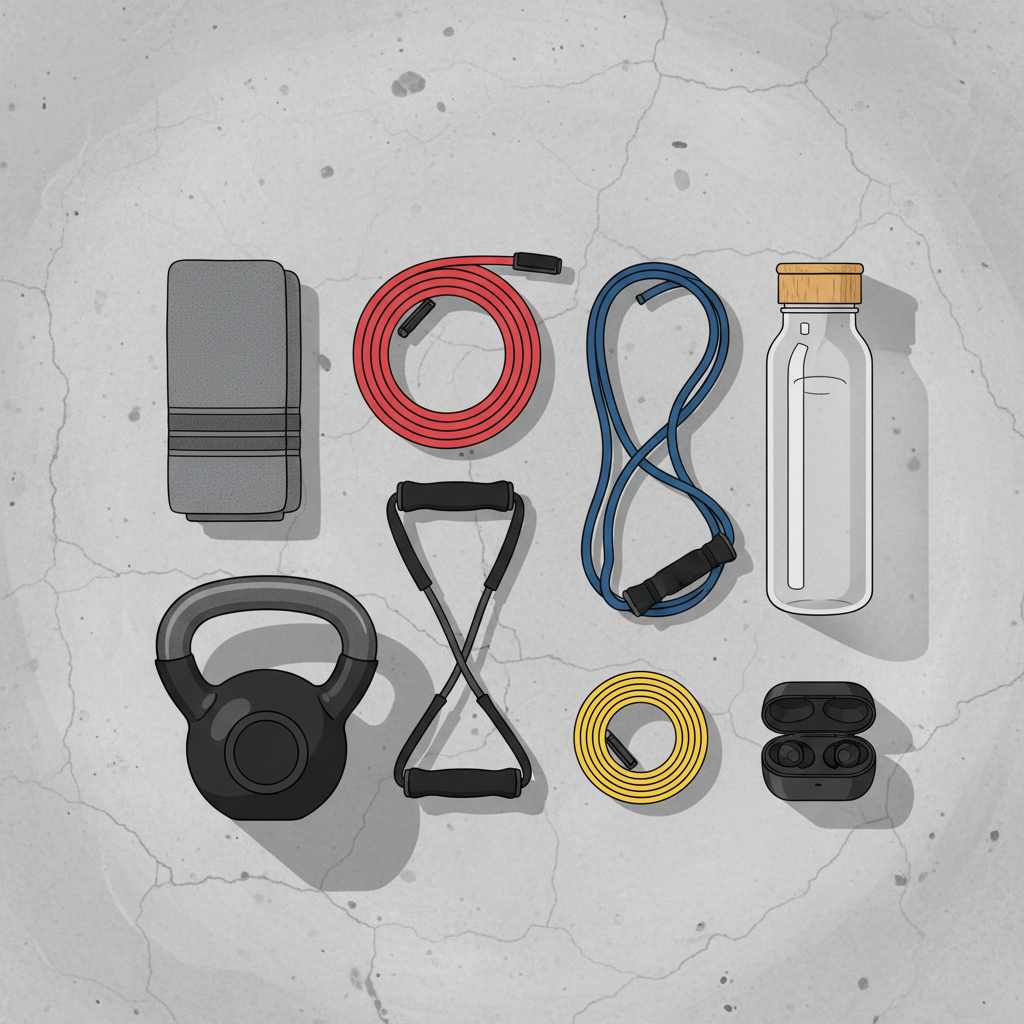
Programming guide
Effective training requires a plan. Use these guidelines to structure your resistance band workouts for consistent progress. The key is progressive overload: you must continually challenge your muscles by increasing reps, upgrading to a stronger band, or increasing training volume (total sets).
A good starting point for reps is the 8-15 range for muscle growth (hypertrophy) and 15-25 for muscular endurance. Rest 60-90 seconds between sets. Aim to train each major muscle group 2-3 times per week.
| Experience Level | Total Sets per Muscle Group per Week | Frequency per Muscle Group | Progression Strategy |
|---|---|---|---|
| Beginner | 10-12 sets | 2x per week | Master form, then increase reps. When you can hit the top of the rep range (e.g., 15 reps) for all sets, move to the next band level. |
| Intermediate | 12-18 sets | 2-3x per week | Increase band tension. Introduce techniques like pauses and slow eccentrics. Increase total weekly sets (volume). |
| Advanced | 16-22+ sets | 2-3x per week | Combine bands with weights (accommodating resistance). Use supersets, drop sets (switching to a lighter band mid-set), and increase training frequency. |
Best exercises / techniques
This is not an exhaustive list, but these exercises form a powerful foundation for a full-body band routine.
- • Banded Glute Bridge - the perfect exercise to activate your glutes before a workout or as a primary strengthening move. The band forces your gluteus medius (side glutes) to work, improving hip stability.
- • Banded Squat - by placing a band around your knees, you're forced to actively push your knees out, correcting valgus collapse (knee cave) and firing up your glutes and quads.
- • Banded Pull-Apart - an essential movement for posture and shoulder health. It directly targets the often-neglected muscles of your upper back and rear deltoids.
- • Pallof Press - a top-tier anti-rotation core exercise. The band tries to twist your torso, and your core must work hard to resist that movement, building true functional strength.
- • Banded Row - a fantastic back builder that can be anchored anywhere. It strengthens the lats, rhomboids, and biceps, crucial for a strong and balanced upper body.
- • Banded Push-Up - adds resistance to a classic bodyweight move. As you press up, the band tension increases, challenging your chest, shoulders, and triceps most at the top of the movement.
- • X-Band Walk - a great dynamic movement for hip and glute strength. It improves stability for walking, running, and squatting.
Sample week template
This full-body template is a sustainable and effective way to train with resistance bands. Focus on the quality of each rep. "Volume" refers to the total number of work sets for the main exercises.