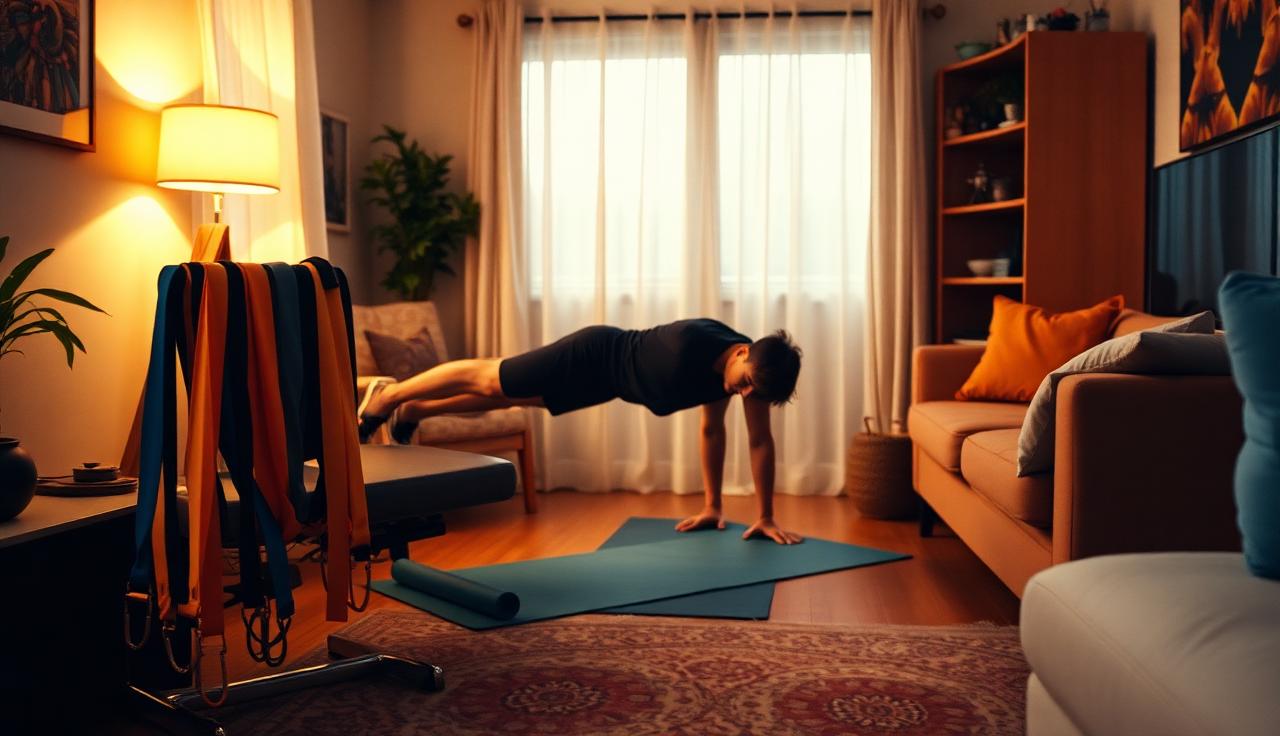
The gym isn't a building; it's a mindset. With the right knowledge and a solid plan, your living room, garage, or spare bedroom can become a powerful catalyst for building muscle, improving your health, and forging mental resilience. This is your definitive guide to making home workouts not just a temporary substitute, but a genuinely effective and sustainable part of your fitness journey.
What "Home Workout" actually means - clear definition + why it matters
A "home workout" is any form of physical training performed outside of a traditional gym or fitness studio, typically within your personal living space. This isn't just about convenience- it's a fundamental shift in approach. It prioritizes efficiency, creativity, and consistency over access to complex machinery. The core principle is leveraging your bodyweight and minimal, versatile equipment to create a stimulus strong enough to force adaptation- whether that's muscle growth, fat loss, or improved cardiovascular fitness.
This matters because it removes the most common barriers to exercise - time, cost, and intimidation. There's no commute, no membership fee, and no one watching you. This empowers you to take full ownership of your fitness, integrating it seamlessly into your life rather than scheduling your life around the gym. It's the ultimate expression of accessible, self-directed health.

The science behind it - physiology / mechanics / energy systems
Effective home workouts operate on the exact same physiological principles as gym-based training. Your muscles don't know if you're lifting a dumbbell or a heavy backpack- they only know tension, stress, and the demand to produce force. The primary driver of muscle growth (hypertrophy) is mechanical tension, which is achieved through the principle of progressive overload. This means continually challenging your muscles to do more than they're used to. At home, you can achieve this by adding reps, increasing sets, reducing rest time, improving your form, or using more challenging exercise variations (e.g., moving from a standard push-up to a decline push-up).
Your body uses three main energy systems to fuel movement. The ATP-PC system powers short, explosive efforts (like a single box jump). The glycolytic system fuels moderately long efforts (like a 30-60 second set of squats). The oxidative system supports long-duration, lower-intensity activity (like a brisk walk or light jogging). A well-designed home workout plan strategically targets these systems. High-Intensity Interval Training (HIIT) primarily taxes the glycolytic system for a powerful metabolic effect, while a strength circuit with 60-90 second rests focuses on mechanical tension and hypertrophy.
Key benefits - 5-8 specific, measurable benefits in a Markdown table
| Benefit | Mechanism | Realistic Timeline |
|---|---|---|
| Increased Muscular Strength & Endurance | Progressive overload via mechanical tension and metabolic stress. | 4-6 weeks for noticeable strength gains. |
| Improved Body Composition (Fat Loss) | Increased daily energy expenditure and elevated post-exercise metabolic rate (EPOC). | 8-12 weeks for visible changes, with consistent nutrition. |
| Enhanced Cardiovascular Health | Elevated heart rate strengthens the cardiac muscle and improves oxygen utilization (VO2 max). | 2-4 weeks for lower resting heart rate and improved stamina. |
| Greater Convenience & Consistency | Removal of common barriers like travel time, gym hours, and membership costs. | Immediate. Consistency builds within the first 2-3 weeks. |
| Improved Joint Health & Mobility | Full range of motion movements strengthen connective tissues and improve synovial fluid circulation. | 4-8 weeks for reduced stiffness and better movement quality. |
| Better Mental Health & Reduced Stress | Release of endorphins and reduction of cortisol levels through physical exertion. | Immediately after a session; cumulative mood benefits in 1-2 weeks. |
| Cost-Effectiveness | Minimal to zero financial investment required compared to gym memberships. | Immediate and ongoing financial savings. |
Common mistakes to avoid - bulleted list of 6-10 mistakes with 1-line fix each
- • No Real Plan - just doing random exercises you saw online without structure.
- • Fix - follow a structured program (like one from Fullbody AI) that specifies exercises, sets, and reps.
- • Forgetting Progressive Overload - doing the same 3 sets of 10 push-ups every week.
- • Fix - aim to add one rep, one set, or use a harder variation each week.
- • Ignoring the Warm-Up - jumping straight into high-intensity movements cold.
- • Fix - perform 5-10 minutes of dynamic stretching (e.g., leg swings, arm circles) and light cardio first.
- • Sacrificing Form for Reps - rushing through movements with sloppy technique.
- • Fix - slow down, focus on the mind-muscle connection, and stop the set when form breaks down.
- • Only Doing Cardio - neglecting strength training, which builds metabolism-boosting muscle.
- • Fix - ensure at least 2-3 sessions per week include resistance-based exercises.
- • Inconsistent Schedule - working out intensely for three days, then taking a week off.
- • Fix - schedule your workouts like appointments and aim for consistency over intensity.
- • Not Creating a Dedicated Space - trying to work out in a cluttered, distracting area.
- • Fix - designate a specific, clean spot for your workouts, even if it's just a small corner.
- • Neglecting Posterior Chain - over-focusing on mirror muscles (chest, abs) and ignoring the back, glutes, and hamstrings.
- • Fix - for every pushing exercise (like push-ups), include a pulling exercise (like inverted rows).
Programming guide - sets, reps, frequency, progression rules
Your programming dictates your results. The key variables are volume (sets x reps x weight), frequency (how often you train), and intensity (how hard you train, often measured by proximity to failure). For most goals, training 3-5 times per week is the sweet spot. A full-body routine 3x per week or an upper/lower split 4x per week are excellent home-based options.
Progression is simple - each week, try to beat your previous performance. This could be adding one rep to all sets, adding an extra set to a key exercise, or progressing to a more difficult variation of an exercise once you can comfortably hit the top of your target rep range. For example, once you can do 3 sets of 15 bodyweight squats with perfect form, it's time to try goblet squats.
| Experience Level | Weekly Direct Sets Per Muscle Group | Recommended Frequency | Reps In Reserve (RIR) |
|---|---|---|---|
| Beginner | 8-12 sets | 2-3x Full Body | 3-4 RIR (stop 3-4 reps shy of failure) |
| Intermediate | 12-18 sets | 3-4x Full Body or Upper/Lower | 2-3 RIR (stop 2-3 reps shy of failure) |
| Advanced | 18-22+ sets | 4-5x Upper/Lower or Body Part Split | 0-2 RIR (train close to or at failure) |
Best exercises / techniques - list with 1–2 sentence "why" for each
- • Bulgarian Split Squat - this single-leg exercise destroys your quads and glutes while also improving balance and hip mobility. It's a true leg-day replacement you can do with just your bodyweight or a single dumbbell.
- • Pike Push-Up / Handstand Push-Up - this is how you build powerful shoulders without an overhead press machine. By elevating your feet, you shift the load directly onto your deltoids, creating vertical pressing tension.
- • Inverted Row - the perfect counterbalance to the push-up, this exercise builds a strong upper back and biceps. You can perform these using a sturdy table, two chairs and a broomstick, or gymnastics rings.
- • Single-Leg Romanian Deadlift (RDL): This movement targets your hamstrings and glutes one side at a time, fixing imbalances and building incredible stability. It's one of the best hinge pattern exercises you can do at home.
- • Hollow Body Hold / Plank - these aren't just ab exercises; they are full-body tension drills. They teach your core to brace and stabilize your spine, which is foundational for every other movement.
- • Glute Bridge / Hip Thrust - the number one way to target and strengthen the glutes directly. Progress from a simple bodyweight bridge to a single-leg version or add weight across your hips.
- • Tempo Training - this isn't an exercise, but a technique. Slowing down the eccentric (lowering) phase of a lift (e.g., a 3-second descent on a squat) dramatically increases time under tension and mechanical stress, making any exercise harder and more effective.
Sample week template - Markdown table with Day | Focus | Volume | Notes (7 rows)
This is a classic 3-day full-body split for a beginner or intermediate trainee.
| Day | Focus | Volume | Notes |
|---|---|---|---|
| 1 | Full Body A (Push Focus) | 4 exercises, 3-4 sets each | Focus on squats, push-ups, lunges, and a plank variation. |
| 2 | Active Recovery | N/A | 30-45 minute walk, light stretching, or foam rolling. |
| 3 | Full Body B (Pull Focus) | 4 exercises, 3-4 sets each | Focus on glute bridges, inverted rows, RDLs, and a side plank. |
| 4 | Active Recovery | N/A | Go for a hike, do some yoga, or simply rest. |
| 5 | Full Body A (Progression) | 4 exercises, 3-4 sets each | Repeat Day 1's workout, but aim to add 1-2 reps to each set. |
| 6 | Rest | N/A | Full rest day. Focus on nutrition and hydration. |
| 7 | Rest | N/A | Your body builds muscle during rest, not during training. |