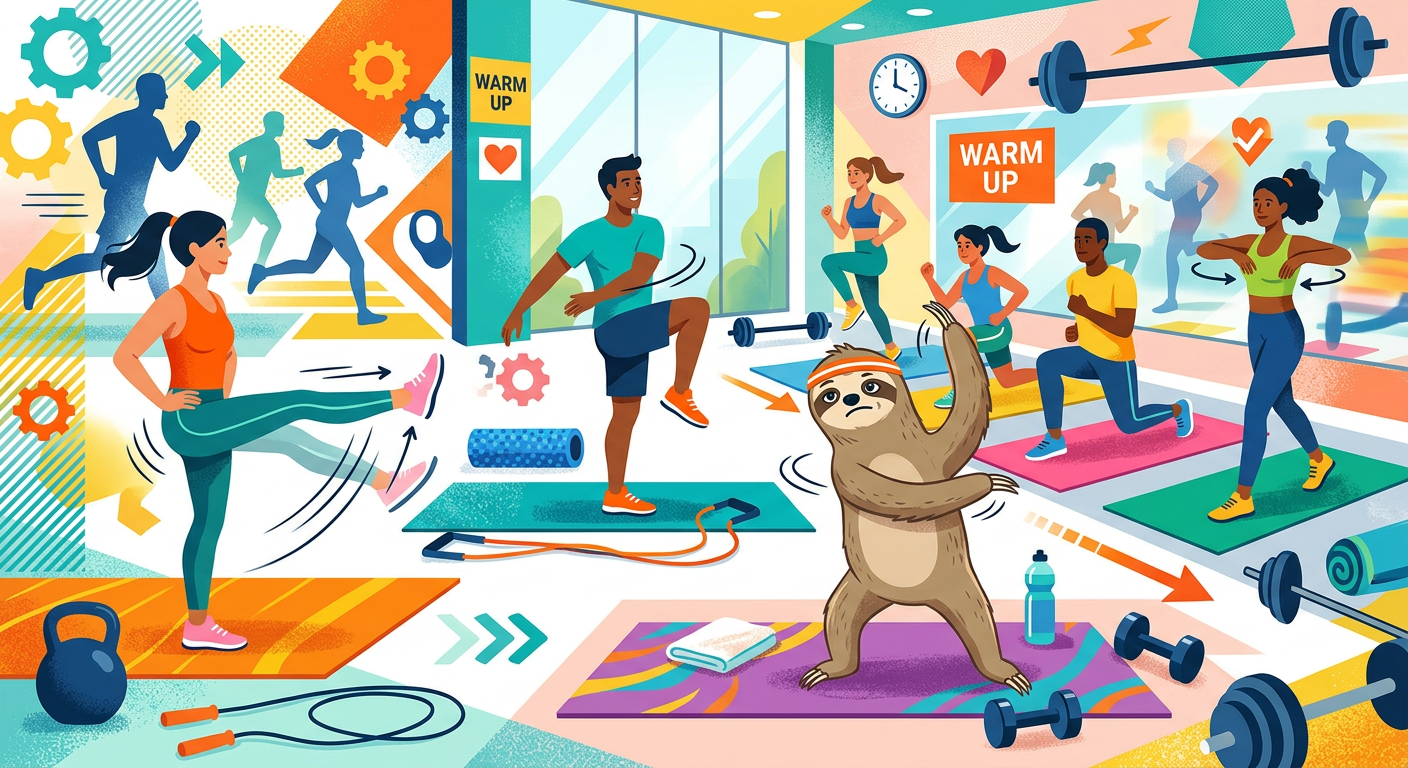
Flexibility is often the unsung hero of a well-rounded fitness regimen, the secret ingredient that unlocks better movement, prevents injury, and enhances long-term performance. It’s not about contorting yourself into a pretzel; it's about giving your body the freedom to move powerfully and efficiently through its intended range of motion. Think of it as investing in your body’s long-term health, one deliberate stretch at a time, moving with the graceful purpose of our sloth mascot.
What "Flexibility" Actually Means - Clear Definition + Why It Matters
Flexibility is technically defined as the ability of a joint or series of joints to move through an unrestricted, pain-free range of motion (ROM). It's a component of mobility, which also includes strength and control through that ROM. True flexibility isn't just about passive length - for instance, how far someone else can move your limb. It's about your muscles, tendons, ligaments, and fascia having the pliability to allow for full movement.
Why does this matter? Limited flexibility acts like a parking brake on your physical potential. If your hips are tight, you can't squat to full depth, which limits muscle activation and strength gains. If your shoulders are stiff, your overhead press form breaks down, increasing the risk of impingement. Improving flexibility is fundamental to better movement quality, which translates to superior performance in the gym and a higher quality of life outside of it.

The Science Behind It - Physiology / Mechanics / Energy Systems
When you stretch a muscle, you're not just pulling on a simple elastic band. You're influencing a complex system governed by your nervous system and the physical properties of your tissues. Two key players are the sensory receptors within your muscles - muscle spindles and Golgi Tendon Organs (GTOs). Muscle spindles detect changes in muscle length and the speed of that change. If you stretch too fast, they trigger a protective "stretch reflex," causing the muscle to contract and resist the stretch.
Conversely, the GTOs, located where the muscle meets the tendon, sense tension. When you hold a gentle, prolonged stretch (like in static stretching), the GTOs are stimulated. After about 6-10 seconds, they signal the muscle to relax, overriding the stretch reflex. This neurological relaxation is known as autogenic inhibition, and it's the primary mechanism that allows a muscle to lengthen and improve flexibility over time.
Your connective tissues (fascia, tendons, ligaments) also have viscoelastic properties. This means they have both elastic (ability to return to original shape) and viscous (resistance to flow) qualities. Consistent stretching helps to remodel these tissues, making them more pliable and capable of handling greater ranges of motion. This process is slow and requires very little energy from metabolic systems like glycolysis or oxidative phosphorylation; it's primarily a mechanical and neurological adaptation.
Key Benefits - 5-8 Specific, Measurable Benefits
| Benefit | Mechanism | Realistic Timeline |
|---|---|---|
| Improved Joint Range of Motion (ROM) | Neurological adaptation (autogenic inhibition) and mechanical changes in connective tissue (viscoelasticity). | Noticeable change in 2-4 weeks; significant improvement in 8-12 weeks of consistent work. |
| Reduced Risk of Muscle Strains | Increased muscle-tendon compliance allows tissues to absorb more force before reaching their mechanical failure point. | Gradual risk reduction over 3-6 months as tissue quality adapts. |
| Enhanced Strength Potential | Ability to perform exercises like squats and lunges through a full ROM allows for greater muscle fiber recruitment and hypertrophy. | Strength gains can be seen within 4-6 weeks once ROM allows for better form. |
| Decreased Delayed Onset Muscle Soreness (DOMS) | Gentle stretching post-workout can help downregulate the nervous system and may increase blood flow, aiding recovery. | Immediate, short-term relief post-session; not a cure for DOMS but can reduce perceived soreness. |
| Better Posture and Body Awareness | Lengthening chronically tight muscles (e.g., hip flexors, pecs) allows for proper joint alignment and improved proprioception. | Postural improvements can be felt within 4-8 weeks, with visible changes in 3+ months. |
| Stress Reduction | Slow, diaphragmatic breathing during stretching activates the parasympathetic nervous system, promoting a state of calm. | Immediate effects during and after each session. |
Common Mistakes to Avoid - Bulleted List
- • Stretching cold muscles. This increases the risk of strain as cold tissues are less pliable.
- • Fix - always perform a 5-10 minute general warm-up (e.g., light cardio) before static stretching.
- • Using ballistic (bouncing) stretches. Bouncing can trigger the stretch reflex, causing the muscle to tighten defensively.
- • Fix - ease into stretches slowly and hold them steadily, breathing throughout the hold.
- • Pushing into sharp pain. Pain is a signal that you're pushing tissue beyond its current capacity.
- • Fix - stretch to the point of mild tension or discomfort, never sharp pain. Back off if you feel any.
- • Holding your breath. This creates body-wide tension and limits the nervous system's ability to relax.
- • Fix - inhale as you prepare, and exhale slowly as you deepen into the stretch.
- • Inconsistency. Stretching for 30 minutes once a week is less effective than 5-10 minutes daily.
- • Fix - integrate short, frequent flexibility sessions into your daily routine (e.g., after a workout, before bed).
- • Only using static stretching. Neglecting dynamic stretching pre-workout and mobility work misses key benefits.
- • Fix - use dynamic stretches in your warm-up and dedicated mobility drills on active recovery days.
- • Forgetting to strengthen new ranges. Gaining passive ROM without building control can lead to instability.
- • Fix - incorporate strength exercises that work the muscle in its newly acquired, lengthened position.
- • Comparing your flexibility to others. Everyone has a unique anatomical structure and training history.
- • Fix - focus on your own consistent progress, tracking your personal improvements over time.
Programming Guide - Sets, Reps, Frequency, Progression Rules
Effective flexibility programming is about consistency and appropriate volume. For static stretching, think in terms of total time under tension for each muscle group per week. A good starting point is 2-4 sets of 20-45 second holds per major muscle group.
Progression - the primary way to progress is by increasing the range of motion. Once you can comfortably hold a stretch at a certain depth, gently try to sink a little deeper on the exhale. You can also progress by increasing the hold time (up to 60 seconds) or adding another set. Listen to your body and aim for small, consistent gains.
| Experience Level | Frequency per Week | Session Duration | Total Weekly Volume (per muscle group) |
|---|---|---|---|
| Beginner | 3-5 days | 10-15 minutes | 60-120 seconds |
| Intermediate | 4-6 days | 15-25 minutes | 120-180 seconds |
| Advanced | 5-7 days | 20-30+ minutes | 180-300 seconds |
Best Exercises / Techniques - List with "Why"
- • Static Stretching - the classic "hold" stretch, best done post-workout when muscles are warm. This is ideal for increasing passive range of motion.
- • Dynamic Stretching - active movements that take a joint through its full ROM, performed pre-workout. Think Leg Swings or Arm Circles. They increase body temperature and prepare the nervous system for activity.
- • PNF (Proprioceptive Neuromuscular Facilitation): An advanced technique, often done with a partner. The most common method is "contract-relax," where you contract the target muscle against resistance for 5-10 seconds, then relax and move deeper into the stretch for 20-30 seconds. PNF leverages autogenic inhibition for rapid flexibility gains.
- • Controlled Articular Rotations (CARs): Active, slow, and controlled rotations of a joint at its outer limits. CARs are excellent for improving joint health, mobility, and active control over your range of motion.
- • World's Greatest Stretch - a fantastic full-body dynamic stretch. It targets hip flexors, hamstrings, glutes, and thoracic spine mobility all in one fluid movement.
- • Couch Stretch - a potent static stretch for the quads and hip flexors (rectus femoris and psoas). It's incredibly effective at undoing the negative effects of prolonged sitting.
- • Pigeon Pose - a deep static stretch for the external hip rotators (like the piriformis) and glutes. This can help alleviate sciatic-like pain and improve hip mobility for squats.