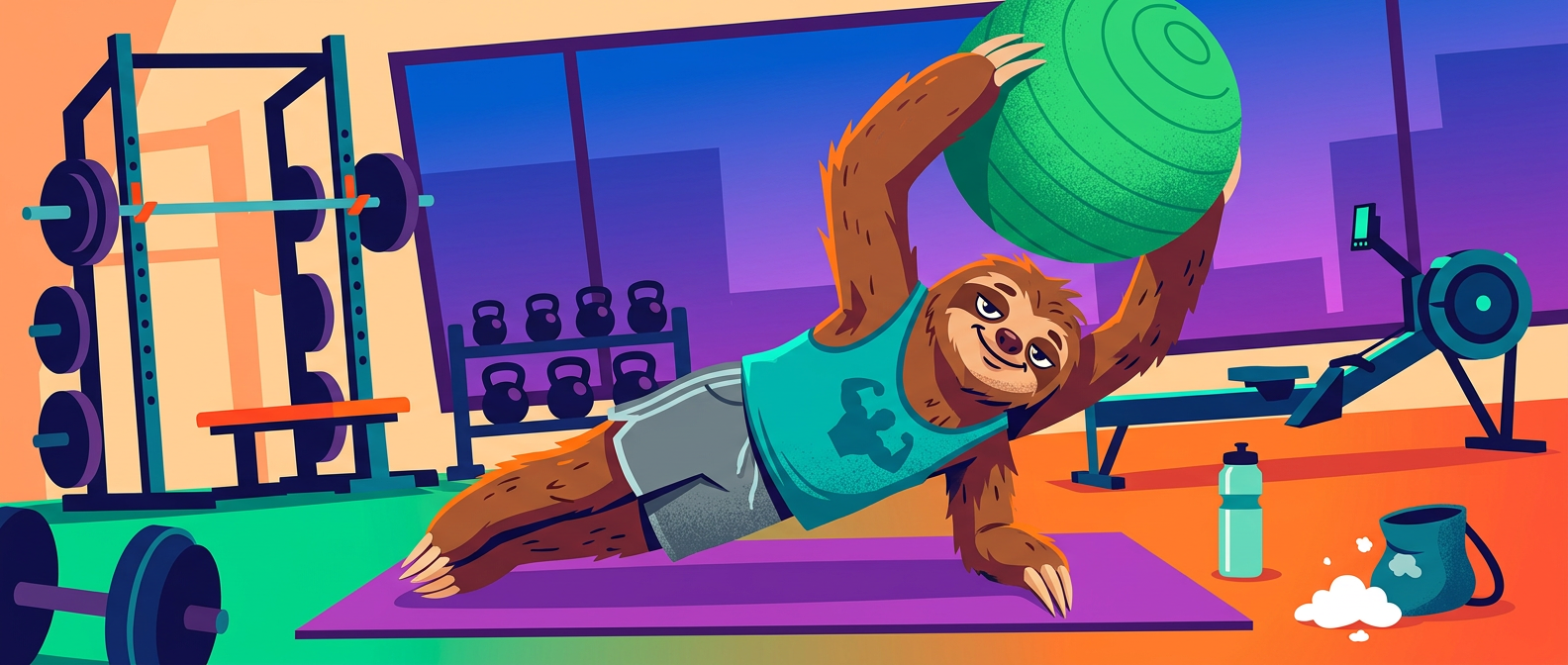


Welcome to the Core category on the Fullbody AI blog, your central hub for building a truly powerful and resilient midsection. Forget the endless crunches for a moment; we're here to redefine what a strong core means and show you how to build one that serves as the unshakable foundation for every move you make. Here at Fullbody AI, even our relaxed sloth mascot knows that a stable center is the secret to moving well and staying injury-free for life.
What "Core" actually means - clear definition + why it matters
When most people hear "core," they picture the rectus abdominis-the coveted "six-pack" muscles. While those are part of the equation, the true core is a complex, 3D cylinder of muscle that wraps around your entire torso. It's not just the front; it's the front, sides, and back, all working in harmony.
Think of it as a muscular corset. This system includes the rectus abdominis for flexing the spine, the internal and external obliques for rotation and side-bending, and the deep transverse abdominis-your body's natural weightlifting belt. It also includes the erector spinae and multifidus in your back for extension, the diaphragm on top as a breathing muscle, and the pelvic floor at the bottom as the foundation.
Why does this matter? Because this muscular cylinder is the critical link that transfers force between your upper and lower body. Every time you push, pull, lift, or twist, power travels through this central hub. A weak core is like a power leak; a strong core is a force multiplier, improving performance in everything from lifting groceries to hitting a new personal record on your squat.
The science behind it - physiology / mechanics / energy systems
The primary mechanical job of the core is not to create movement, but to resist it. Its main function is to provide spinal stability. It does this by generating intra-abdominal pressure (IAP). When you properly brace, your core muscles contract, pressing inward on your abdominal cavity. Since the contents are mostly fluid-filled and incompressible, this pressure creates a rigid, solid trunk that protects your spine from buckling under load.
This principle is best understood through four key anti-movement patterns:
- Anti-Extension - resisting the urge to arch your lower back (e.g., during a plank or overhead press).
- Anti-Rotation - resisting twisting forces on the spine (e.g., during a single-arm row or a Pallof press).
- Anti-Lateral Flexion - resisting bending to the side (e.g., when carrying a heavy bag in one hand).
- Spinal Flexion - while often overemphasized (e.g., crunches), controlled spinal flexion is still a necessary function.
- • Mistake - living on crunches. Fix - prioritize anti-movement exercises like planks, dead bugs, and Pallof presses.
- • Mistake - arching your low back in planks. Fix - actively squeeze your glutes and tuck your pelvis slightly (posterior pelvic tilt).
- • Mistake - holding your breath incorrectly. Fix - learn to brace your abs while taking shallow breaths; don't just hold your breath and turn purple.
- • Mistake - rushing through reps. Fix - slow down and focus on control and time under tension, pausing at the point of peak contraction.
- • Mistake - forgetting your back. Fix - include exercises that target your spinal erectors, like bird-dogs or back extensions.
- • Mistake - neglecting rotational stability. Fix - incorporate anti-rotation exercises like Pallof presses or renegade rows at least once a week.
- • Mistake - going for max time instead of quality. Fix - stop your set when your form breaks down, even if the clock is still ticking.
- • Mistake - never adding difficulty. Fix - apply progressive overload by increasing hold times, adding weight, or increasing the lever arm (e.g., straight legs vs. bent knees).
- Increase Duration - add 5-10 seconds to your holds each week.
- Increase Reps - add 1-2 reps to your sets each week.
- Add Load - hold a weight plate on your back during a plank or hold a dumbbell during leg raises.
- Increase Lever Arm - progress from a bent-knee dead bug to a straight-leg dead bug.
- Decrease Stability - perform a plank with your feet on a stability ball instead of the floor.
- • Plank - the quintessential anti-extension exercise. It teaches you to create full-body tension and resist gravity's pull on your lumbar spine.
- • Dead Bug - excellent for learning to keep your core braced and spine neutral while your limbs are in motion. It builds incredible motor control.
- • Side Plank - the best exercise for building anti-lateral flexion strength. It targets the obliques and quadratus lumborum (QL), crucial muscles for hip and spine health.
- • Bird-Dog - this movement challenges anti-rotation stability while also strengthening the spinal extensors. It's a fantastic exercise for coordinating opposite limbs.
- • Pallof Press - pure, isolated anti-rotation training. By pressing a band or cable away from your chest, you force your obliques to fire hard to prevent your torso from twisting.
- • Hanging Knee or Leg Raise - a great way to train spinal flexion under load. It also strengthens the hip flexors and improves grip strength.
- • Suitcase Carry - a dynamic anti-lateral flexion exercise. It forces your core to work overtime to keep your torso upright while you walk with a load on one side.
- • Ab Rollout - an advanced anti-extension movement. It challenges your core through a huge range of motion, requiring immense strength to prevent your back from arching.
From an energy systems perspective, core training is primarily anaerobic. The intense, short-duration bracing required for a heavy lift or a stability exercise relies on the ATP-PC and glycolytic systems for quick, powerful contractions. However, exercises that require stabilization for longer durations (like a 60-second plank) will also challenge local muscular endurance.
Key benefits - 5-8 specific, measurable benefits in a Markdown table
A strong, functional core pays dividends far beyond the mirror. These benefits are tangible, measurable, and impact your daily life and athletic pursuits.
| Benefit | Mechanism | Realistic Timeline |
|---|---|---|
| Reduced Lower Back Pain | Core muscles create intra-abdominal pressure (IAP) to stabilize the lumbar spine, reducing shear forces on vertebrae and discs. | 4-8 weeks |
| Increased Max Lifts (Squat/Deadlift) | A rigid torso provides a stable platform, allowing for maximum force transfer from the legs through the bar without energy leaks. | 2-4 weeks (technique), 8-12 weeks (strength) |
| Improved Athletic Power | A stable core allows for efficient storage and release of elastic energy, particularly in rotational movements (e.g., throwing, swinging). | 6-10 weeks |
| Enhanced Balance & Stability | A strong core acts as a central governor, making constant micro-adjustments to maintain your center of gravity and prevent falls. | 3-6 weeks |
| Better Running Economy | Minimizes excessive torso rotation and vertical oscillation, conserving energy and allowing it to be directed into forward propulsion. | 8-12+ weeks |
| Improved Posture | Strengthens muscles (like the erector spinae and obliques) that hold the spine and pelvis in a more neutral alignment. | 4-12 weeks |
Common mistakes to avoid - bulleted list of 6-10 mistakes with 1-line fix each
Effective core training is about quality over quantity. Avoid these common pitfalls to get the most out of your efforts.
Programming guide - sets, reps, frequency, progression rules
Smart core programming is about consistency and overload, not daily destruction. Your core muscles, like any other muscle group, need time to recover and adapt.
Frequency - aim to train your core directly 2-4 times per week. This can be at the end of your main workouts or on designated active recovery days. Training it daily is counterproductive.
Sets and Reps - for timed exercises like planks, aim for 3-5 sets of holds ranging from 30-75 seconds. For reps-based exercises like leg raises, aim for 3-4 sets of 8-20 reps. In all cases, the last few seconds or reps of each set should be very challenging while maintaining perfect form.
Progressive Overload - to keep making progress, you must continually challenge your core. Here's how:
Here is a general guideline for total weekly direct core work sets (not including the stabilization from compound lifts):
| Experience Level | Total Direct Core Sets Per Week |
|---|---|
| Beginner | 6-9 sets |
| Intermediate | 10-14 sets |
| Advanced | 15-20+ sets |
Best exercises / techniques - list with 1–2 sentence "why" for each
Focus on a variety of exercises that challenge the core's primary functions. Here are some of the most effective movements you can do.