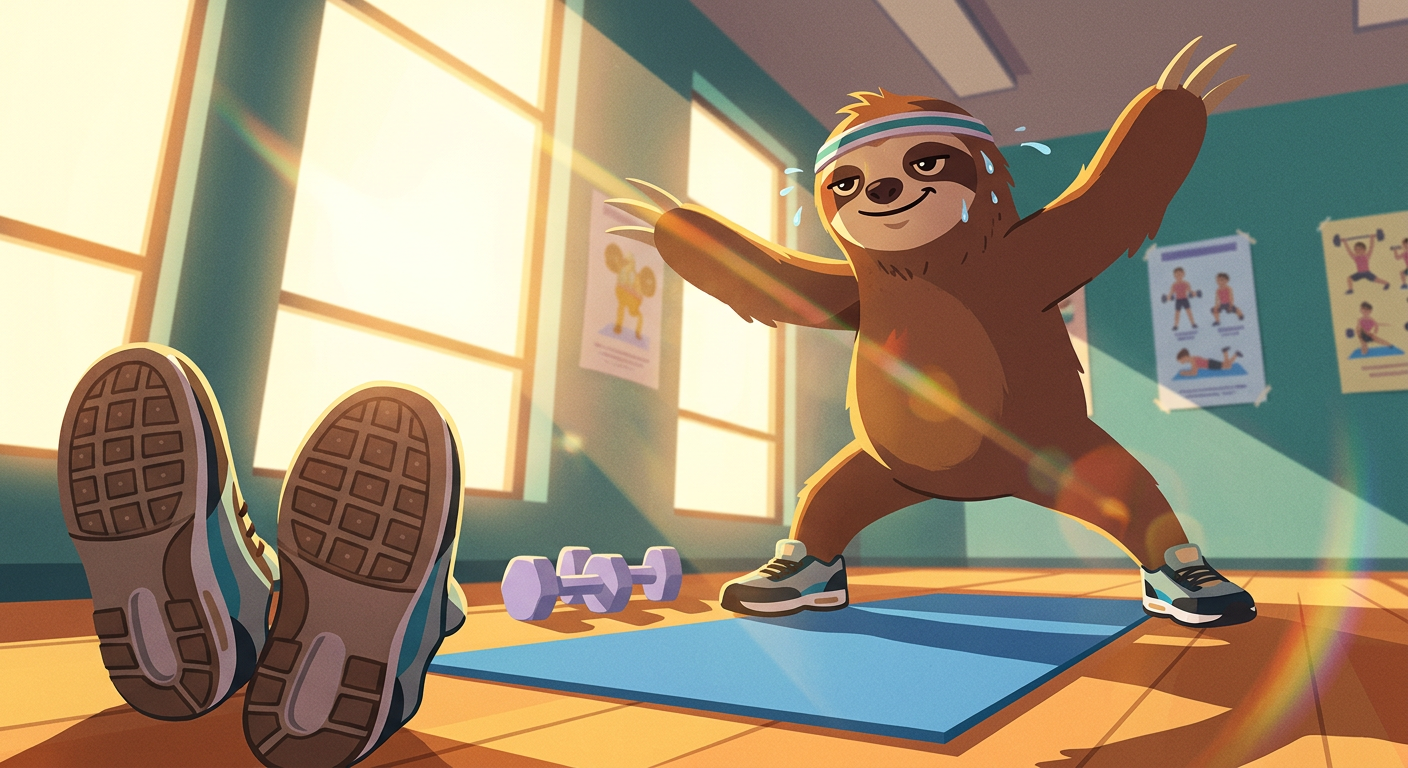



Welcome to the starting line of your fitness journey, the single most important step you can take. Getting started can feel like trying to drink from a firehose of conflicting advice, but it doesn't have to be complicated. This guide is your definitive blueprint for building a strong, resilient, and effective fitness foundation from scratch, with our friendly sloth mascot cheering you on every step of the way.
What "Beginner Workout" actually means
A "beginner workout" isn't an "easy workout"- it's a smart one. This initial phase, typically lasting the first 3-6 months of consistent training, is not about lifting the heaviest weights or pushing to total exhaustion. Instead, it's a strategic period focused on two critical goals - motor learning and building a base.
First, you are teaching your brain and muscles to communicate effectively, a process called building neuromuscular connections. You're mastering fundamental human movement patterns like the squat, hinge, push, and pull. Second, you are conditioning your muscles, tendons, and ligaments to handle future stress. Nailing this phase is the non-negotiable prerequisite for long-term progress and the single best way to prevent injuries down the road. Think of it as earning the right to train harder later.

The science behind it
When you first start lifting, the rapid strength gains you experience aren't just from bigger muscles- they're primarily from your nervous system getting smarter. This is called neuromuscular adaptation. Your brain becomes more efficient at sending signals to your muscles, recruiting more muscle fibers for a given task, and coordinating the firing of those fibers. It’s like upgrading your body's internal software before you upgrade the hardware.
Mechanically, you're grooving movement patterns. By repeatedly performing an exercise like a Goblet Squat with perfect form, you are hard-wiring that motor pattern into your cerebellum. This makes the movement automatic and efficient, allowing you to eventually load it safely with more weight. From an energy perspective, you're training your anaerobic systems- primarily the ATP-PC and glycolytic systems- which provide rapid energy for short, powerful bursts of effort typical in strength training.
Finally, your connective tissues (tendons and ligaments) adapt more slowly than your muscles. A well-designed beginner program applies just enough stress to stimulate them to become stronger and more resilient without overloading them. Rushing this process is a common cause of injuries like tendonitis in more advanced lifters who skipped this foundational work.
Key benefits
Embarking on a structured beginner program yields powerful, measurable results. It's not just about aesthetics; it's about fundamentally upgrading your health and physical capabilities.
| Benefit | Mechanism | Realistic Timeline |
|---|---|---|
| Rapid Strength Gains | Neuromuscular adaptation and improved motor unit recruitment. | 2-4 Weeks |
| Improved Body Composition | Increased muscle protein synthesis and elevated metabolic rate. | 8-12 Weeks |
| Enhanced Posture | Strengthening core stabilizers and posterior chain muscles (back, glutes, hamstrings). | 4-8 Weeks |
| Increased Energy Levels | Improved mitochondrial efficiency and better sleep quality. | 1-3 Weeks |
| Reduced Injury Risk | Stronger connective tissues and mastery of safe movement patterns. | 8-12+ Weeks |
| Better Mood & Mental Clarity | Release of endorphins and brain-derived neurotrophic factor (BDNF). | 1-2 Workouts |
| Improved Insulin Sensitivity | Muscles become more efficient at using glucose from the bloodstream. | 4-6 Weeks |
Common mistakes to avoid
Your enthusiasm is a huge asset, but it can also lead you astray. Avoid these common beginner pitfalls to ensure your journey is smooth, safe, and sustainable.
- • Too Much, Too Soon - jumping into a six-day-a-week routine with massive volume.
- • Fix - start with 2-3 full-body workouts per week and follow a structured plan.
- • Ego Lifting - sacrificing form to lift heavier weight than you can handle safely.
- • Fix - leave your ego at the door; master the movement with a lighter weight first.
- • Program Hopping - constantly switching workouts because you're not seeing instant results.
- • Fix - stick with a well-designed program for at least 4-8 weeks to allow adaptations to occur.
- • Skipping the Warm-up - going from zero to one hundred without preparing your body.
- • Fix - dedicate 5-10 minutes to dynamic stretches like leg swings and cat-cows.
- • Ignoring Rest & Recovery - believing that more workouts always equal more progress.
- • Fix - schedule at least one full rest day per week and prioritize 7-9 hours of sleep.
- • Inconsistency - hitting the gym hard for one week, then taking two weeks off.
- • Fix - treat your workouts like important appointments that you cannot miss.
- • Fear of Asking for Help - being too intimidated to ask a coach for a form check.
- • Fix - remember everyone was a beginner once; a 5-minute form check can save you months of wasted effort.
Programming guide
Effective programming for a beginner revolves around three principles - consistency, simplicity, and progressive overload. Your goal is to stimulate, not annihilate, your muscles.
- • Frequency - aim for 2-3 full-body training sessions per week on non-consecutive days (e.g., Monday, Wednesday, Friday). This allows for adequate recovery while maximizing the frequency of muscle stimulation.
- • Volume (Sets & Reps): A great starting point is 2-3 sets of 8-12 repetitions for each exercise. This range is the sweet spot for learning motor patterns and stimulating muscle growth (hypertrophy).
- • Rest Periods - rest for 60-90 seconds between sets. This is enough time for your short-term energy systems to partially recover, but not so long that your heart rate drops completely.
- • Progressive Overload - this is the master key to long-term results. To force your body to adapt, you must gradually increase the demand. Once you can complete all prescribed sets and reps for an exercise with good form, you have two options for the next session - add 1-2 reps to each set, or increase the weight by the smallest possible increment (e.g., 2.5-5 lbs).
Volume is a crucial variable that should scale with experience. Beginners are highly sensitive to training and require less volume to grow.
| Experience Level | Weekly Sets Per Major Muscle Group |
|---|---|
| Beginner (0-6 months) | 10-12 sets |
| Intermediate (6-24 months) | 12-18 sets |
| Advanced (2+ years) | 18-25+ sets |
Best exercises / techniques
Focus on compound exercises that deliver the most bang for your buck by working multiple muscle groups simultaneously. These are the foundational pillars of strength.
- • Goblet Squat - this is the ultimate squat teacher. Holding a weight in front of you acts as a counterbalance, making it easier to stay upright and sink into a deep, safe squat, training your quads, glutes, and core.
- • Incline or Knee Push-ups - the push-up is a masterclass in upper-body pressing strength and core stability. Elevating your hands on a bench or performing them on your knees reduces the load, allowing you to perfect the form.
- • Dumbbell Row - this is a core pulling movement for a strong, healthy back. Performing it one arm at a time helps correct strength imbalances and engages your core to resist rotation.
- • Plank - more than just an ab exercise, the plank teaches you to create total-body tension. It builds isometric strength in your core, which is essential for protecting your spine during heavier lifts.
- • Glute Bridge - this simple move isolates and activates your glutes, the powerhouse of your body. Strong glutes are critical for posture, power, and preventing low back pain.
- • Dumbbell Overhead Press - a fundamental movement for building strong, stable shoulders. Performing it while seated can help you focus on the pressing motion without using leg drive.
- • Romanian Deadlift (RDL): The RDL is the best way to learn the hip-hinge pattern, which is crucial for lifting anything off the floor. It builds powerful hamstrings and glutes while reinforcing a neutral spine.
Sample week template
This template puts all the principles together into a simple, effective, and repeatable weekly schedule. "Workout A" and "Workout B" should consist of 4-6 of the compound exercises listed above.