

The barbell is more than just a piece of iron- it's the most effective tool for building whole-body strength, muscle, and resilience. It's a symbol of progress and the foundation of countless powerful physiques. This definitive guide will teach you the science, technique, and programming principles to unlock your true potential with a barbell, guided by the same expert principles that power the Fullbody AI workout planner.
What "Barbell" actually means - clear definition + why it matters
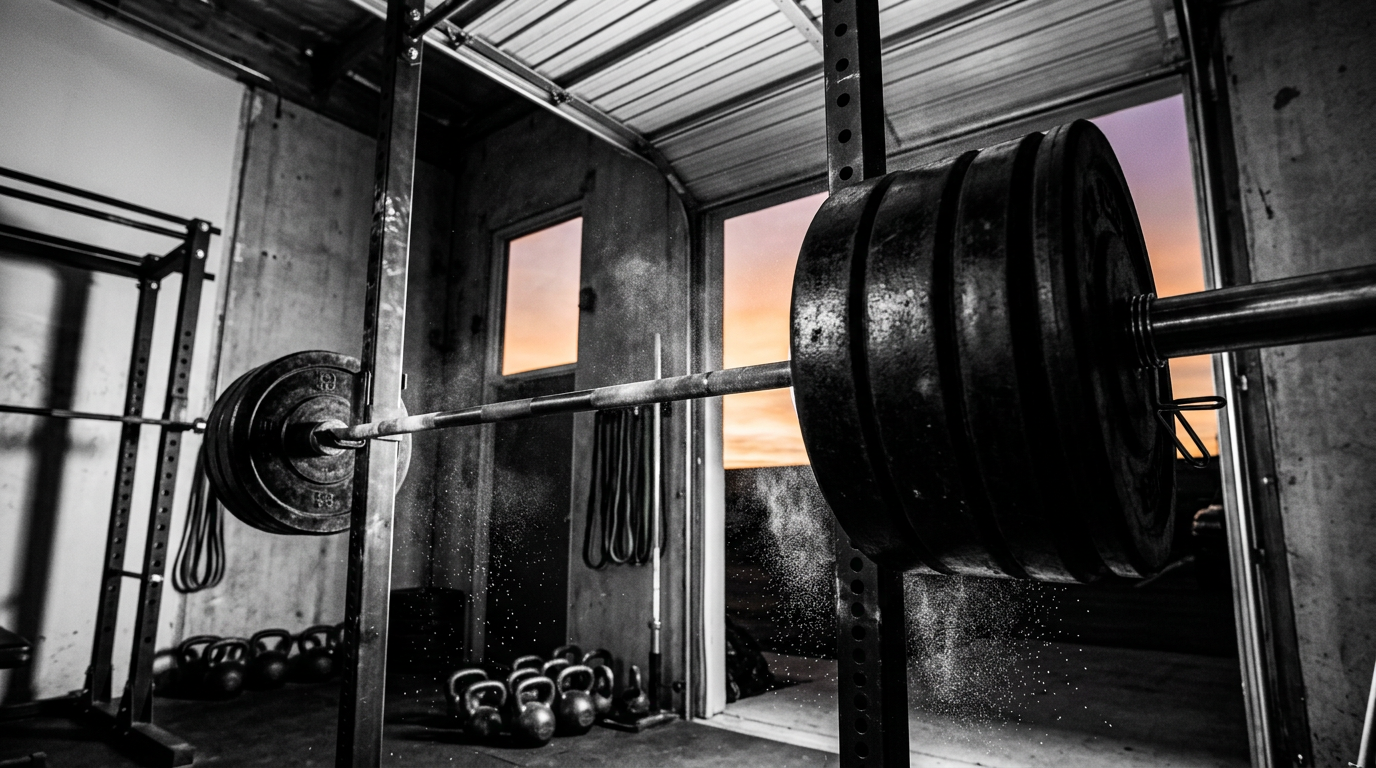
A barbell is a long, straight iron bar used in strength training. A standard Olympic barbell is 7.2 feet long, weighs 20 kilograms (or 45 pounds), and has rotating sleeves at each end where weight plates are loaded. These sleeves spin independently of the bar, which is crucial for reducing torque on your wrists and elbows during dynamic lifts like the clean and jerk.
The bar's shaft is covered in a diamond-patterned texture called knurling, which provides a secure grip. The true magic of the barbell lies in its design for bilateral loading- allowing both sides of the body to work together to move the maximum possible weight. This makes it the undisputed king for progressive overload, the fundamental principle of getting stronger over time by incrementally adding weight.
The science behind it - physiology / mechanics / energy systems
Barbell training triggers a powerful cascade of adaptations in the body. Mechanically, it allows you to create the highest levels of muscular tension and systemic stress. Lifts like squats and deadlifts challenge your entire structure as a coordinated system, improving intermuscular coordination and teaching your Central Nervous System (CNS) to recruit more motor units more efficiently.
Physiologically, this high mechanical tension is a primary driver of muscle hypertrophy (growth). It also creates a significant metabolic demand, forcing your body to become more efficient. Heavy, compound lifts stimulate a potent hormonal response, including an acute increase in growth hormone and testosterone, which supports muscle repair and growth. On a cellular level, the stress on bone from axial loading (loading along the spine) stimulates osteoblasts- cells that build new bone tissue- leading to increased bone density over time (a principle known as Wolff's Law).
From an energy systems perspective, heavy barbell lifting primarily taxes the ATP-PC (phosphagen) system. This system provides explosive energy for short bursts of intense effort, typically lasting less than 10-15 seconds. This is why sets of 1-5 reps are ideal for pure strength development. As rep ranges increase into the 8-15 range for hypertrophy, the glycolytic system contributes more significantly, producing energy by breaking down glucose.
Key benefits - 5-8 specific, measurable benefits in a Markdown table
| Benefit | Mechanism | Realistic Timeline |
|---|---|---|
| Maximal Strength Gains | The barbell allows for the heaviest absolute loads, maximizing mechanical tension and neuromuscular adaptation. | Strength increases are noticeable within 2-4 weeks. |
| Efficient Muscle Growth | Compound movements recruit a huge volume of muscle fibers across multiple joints in a single exercise. | Visible muscle changes can be seen in 8-12 weeks with consistent training and nutrition. |
| Improved Bone Density | Axial loading during lifts like squats and overhead presses directly stimulates bone-building cells. | Significant changes require 6+ months, but the process begins immediately. |
| Enhanced Athleticism | Develops raw power, coordination, and force transfer capabilities that directly apply to sports and life. | Measurable improvements in jumping and sprinting can occur within 12 weeks. |
| Increased Metabolic Rate | Building more muscle mass increases your resting metabolic rate, as muscle tissue is more metabolically active than fat. | Every 1kg of muscle gained burns an additional ~13 calories per day at rest. |
| Corrects Imbalances | Forces both limbs to work together to move a fixed object, highlighting and correcting left-to-right strength discrepancies. | Awareness of imbalances is immediate; correction can take 8-16 weeks of focused work. |
| Mental Fortitude | Systematically facing and overcoming the challenge of a heavy weight builds discipline, focus, and resilience. | This benefit is ongoing and develops with every challenging session. |
Common mistakes to avoid - bulleted list of 6-10 mistakes with 1-line fix each
- • Ego Lifting - using more weight than you can handle with proper form.
- • Fix - select a weight that allows you to complete every rep with perfect technique and control.
- • Inconsistent Range of Motion - performing half-squats or not touching the chest on a bench press.
- • Fix - lower the weight and focus on achieving a full, safe range of motion on every repetition.
- • Skipping Warm-ups - jumping straight into heavy working sets without preparation.
- • Fix - perform 5-10 minutes of dynamic stretching followed by 2-4 lighter ramp-up sets of your first exercise.
- • Neglecting the Upper Back - allowing the upper back to round during deadlifts, squats, or rows.
- • Fix - actively retract your shoulder blades and engage your lats by thinking "pull the bar into your body."
- • Improper Bracing - not creating sufficient intra-abdominal pressure to protect the spine.
- • Fix - before each rep, take a deep belly breath, hold it, and brace your core as if you're about to be punched.
- • Jerking the Bar - using momentum instead of muscular force to initiate a lift (e.g., yanking a deadlift).
- • Fix - focus on creating tension before the bar moves by "pulling the slack out" of the bar.
- • No Structured Program - showing up to the gym without a plan for sets, reps, and progression.
- • Fix - follow a structured program (like one from Fullbody AI) that dictates your exercises and how to progress.
- • Bar Path Inefficiency - allowing the bar to drift too far forward or backward during a lift.
- • Fix - aim for a vertical bar path over the mid-foot for squats, deadlifts, and presses.
Programming guide - sets, reps, frequency, progression rules
Effective barbell programming revolves around the principle of progressive overload. You must consistently give your body a reason to adapt by increasing the demand over time. This can be done by adding weight, adding reps, or adding sets.
- • Sets & Reps - for strength, focus on 3-5 sets of 3-6 reps. For muscle growth (hypertrophy), 3-4 sets of 6-12 reps is the sweet spot. A mix of both is ideal for overall development.
- • Frequency - major muscle groups should be trained 2-3 times per week for optimal growth and skill acquisition. This makes full-body routines or upper/lower splits highly effective.
- • Progression - a simple and effective method is double progression. Aim for a rep range (e.g., 6-8 reps). Once you can hit the top of that range for all your sets, increase the weight by the smallest possible increment (e.g., 2.5-5 lbs) in your next session. Your reps will drop back to the bottom of the range, and you'll work your way back up again.
Here’s a general guide to weekly training volume (total hard sets per major muscle group):
| Experience Level | Weekly Direct Sets Per Muscle Group | Example Frequency |
|---|---|---|
| Beginner | 10-12 sets | Full Body 3x per week |
| Intermediate | 12-18 sets | Upper/Lower Split 4x per week |
| Advanced | 16-22+ sets | Push/Pull/Legs 5-6x per week |
Best exercises / techniques - list with 1–2 sentence "why" for each
- • Back Squat - the king of lower body exercises. It builds immense leg strength, glute development, and core stability by challenging your entire system under load.
- • Deadlift (Conventional/Sumo): The ultimate test of total-body strength. It develops unparalleled posterior chain power (glutes, hamstrings, back) and a vice-like grip.
- • Bench Press - the classic upper-body push movement. It is the best tool for building a powerful chest, front deltoids, and triceps.
- • Overhead Press (OHP): The truest measure of upper body pressing strength and shoulder stability. A strong OHP translates to strength and stability in all other pressing movements.
- • Bent-Over Row - the fundamental barbell lift for building a thick, dense back. It balances out pressing volume and creates a strong, stable torso.
- • Romanian Deadlift (RDL): An essential accessory lift for targeting the hamstrings and glutes. It teaches proper hip-hinge mechanics and builds hamstring flexibility and strength.
- • Hip Thrust - the single best exercise for direct glute isolation and development. It allows you to load the glutes heavily without putting significant stress on the lower back.
Sample week template - Markdown table with Day | Focus | Volume | Notes
This is a classic 3-day, full-body template perfect for beginners or anyone looking for time-efficient, high-frequency training.
| Day | Focus | Example Volume | Notes |
|---|---|---|---|
| Monday | Full Body (Squat Focus) | 5-6 exercises, 3 sets each | Start with Back Squats, then a horizontal press (Bench Press) and a vertical pull (Pull-ups). |
| Tuesday | Active Recovery / Rest | N/A | Focus on mobility, light cardio (like a walk), or complete rest. |
| Wednesday | Full Body (Push Focus) | 5-6 exercises, 3 sets each | Start with Overhead Press, then a hinge movement (RDLs) and a horizontal row (Bent-Over Rows). |
| Thursday | Active Recovery / Rest | N/A | Listen to your body. More walking, stretching, or rest. |
| Friday | Full Body (Deadlift Focus) | 5-6 exercises, 3 sets each | Start with Deadlifts (fewer sets, e.g., 1-3 heavy sets), then an incline press and accessory work. |
| Saturday | Active Recovery / Rest | N/A | Eat well, hydrate, and prepare for the next week. |
| Sunday | Rest | N/A | Complete rest is crucial for supercompensation (growth and adaptation). |
Create Your Workout Plan by Voice - Free, No Signup
Just tell our AI what you want - your goals, schedule, equipment - and get a personalized plan in seconds. No forms, no hassle. Just speak.
Recovery, nutrition & sleep - practical numbers
Training is the stimulus, but growth happens during recovery. You cannot out-train a poor recovery strategy. Prioritize these three pillars, and your results in the gym will skyrocket.
- • Nutrition - fuel your body for performance and repair. Consume 1.6-2.2 grams of protein per kilogram of body weight daily to maximize muscle protein synthesis. Don't neglect carbohydrates, as they replenish glycogen stores and fuel your workouts. A surplus of 250-500 calories over maintenance is a good starting point for muscle gain.
- • Sleep - this is the most potent performance and recovery tool you have. Aim for 7-9 hours of quality sleep per night. During deep sleep, your body releases growth hormone, which is critical for tissue repair.
- • Hydration - even slight dehydration can significantly impair strength and performance. Aim to drink 3-4 liters of water per day, plus additional fluids to replace what you lose during training.
Equipment & alternatives - table comparing options
While the barbell is unparalleled, other tools have their place. Here's how they stack up.
| Equipment | Est. Cost (Home) | Pro | Con |
|---|---|---|---|
| Barbell & Plates | $300 - $1500+ | Highest loading potential; best for maximal strength and compound lifts. | Requires space, a rack for safety, and has a higher initial cost. |
| Dumbbells | $100 - $1000+ | Excellent for unilateral work, correcting imbalances, and greater range of motion. | Can become unwieldy and expensive at heavier weights; less stable. |
| Kettlebells | $50 - $500+ | Unmatched for ballistic exercises (swings, snatches), building explosive power and conditioning. | Less intuitive for traditional strength movements; weight jumps can be large. |
| Bodyweight | $0 | Free and accessible anywhere; great for building a base of strength and control. | Difficult to apply progressive overload for strength once you become proficient. |
FAQ - 6-8 real questions with 2-4 sentence answers each
Q: Is barbell training safe for beginners?
Yes, it's not only safe but highly beneficial. The key is to start with an empty bar to master the movement patterns before adding weight. Focus on impeccable technique and consistency, and the risk of injury is extremely low.
Q: Can I build a complete physique with just a barbell and plates?
Absolutely. A program built around the core barbell lifts- squat, deadlift, bench press, overhead press, and row- will develop strength and muscle across your entire body. These compound movements are the most efficient way to build a powerful, well-rounded physique.
Q: How do I know when to increase the weight on the bar?
A reliable method is the "double progression" model. Pick a rep range (e.g., 5-8 reps). Once you can comfortably complete all of your prescribed sets at the top of that rep range with good form, it's time to increase the weight by the smallest increment possible for your next workout.
Q: What's the difference between an Olympic barbell and a standard barbell?
An Olympic barbell has 2-inch diameter rotating sleeves, weighs 20kg (45lbs), and is built to handle very heavy loads. A standard barbell is typically smaller, has 1-inch fixed sleeves, and has a much lower weight capacity. For serious strength training, always use an Olympic barbell.
Q: Do I need a spotter to lift heavy?
For the barbell bench press, a spotter is highly recommended for heavy sets. For squats, learning to train safely in a power rack with safety arms set at the correct height is a better long-term strategy. For deadlifts and overhead presses, you can simply drop the weight if you fail a lift.
Q: How often should I take a deload week?
A deload is a planned period of reduced training intensity and volume to allow for full recovery. A good rule of thumb is to take a deload every 4-8 weeks of consistent, hard training. You should also take one if you feel overly fatigued, your joints are achy, or your performance has stalled for more than two weeks.
Q: My gym is always crowded. How can I do my barbell workout?
Try training during off-peak hours, like mid-day or later in the evening. Alternatively, have a plan B that uses dumbbells or other equipment to mimic the same movement patterns. The most important thing is to be consistent, even if you have to adapt your plan.
Bottom line - confident closing paragraph that invites the reader to use the AI workout planner
The barbell is a simple tool with profound potential. It’s a direct path to becoming a stronger, more capable, and more resilient version of yourself. Mastering the fundamentals, programming intelligently, and prioritizing recovery are the keys to unlocking that potential. If you're ready to take the guesswork out of your training and get a personalized, progressive barbell program built just for you, let Fullbody AI create your plan. It's time to step up to the bar and build the strength you deserve.