
Wandering into the gym without a plan is like setting off on a road trip without a map-you'll burn some gas, but you probably won't reach your destination. A structured workout plan is your personal roadmap, turning random effort into measurable progress. Here at Fullbody AI, we're all about working smarter, not just harder-a philosophy our wise (and famously efficient) sloth mascot lives by every day.
What "Workout Plan" actually means
A workout plan is far more than just a list of exercises. It's a strategic document designed to guide you from your current fitness level to your specific goal. This blueprint meticulously outlines key variables - which exercises to perform (selection), how many sets and reps to do (volume), how heavy to lift (intensity), how long to rest between sets, and how often to train (frequency). Most importantly, a good plan dictates how to progress over time.
Why does this matter so much? Because our bodies are incredibly adaptive. Doing the same thing over and over leads to a plateau, where progress grinds to a halt. A well-designed workout plan ensures you're consistently providing a stimulus that's just challenging enough to force adaptation-whether that's building muscle, increasing strength, or improving endurance-without causing burnout or injury. It's the difference between exercising and training.

The science behind it
To understand why workout plans work, we need to look at what's happening under the hood. For muscle growth (hypertrophy), three primary mechanisms are at play - mechanical tension, muscle damage, and metabolic stress. Mechanical tension is the force placed on your muscles when you lift weights, especially during the eccentric (lowering) phase. This is the single most important driver of growth. Microscopic muscle damage occurs during intense exercise, signaling the body's repair processes to rebuild the muscle fibers bigger and stronger. Finally, metabolic stress is that "pump" or burning sensation you feel, caused by the buildup of metabolic byproducts like lactate, which can also trigger anabolic signaling.
A structured plan manipulates these factors. Heavier loads in the 1-5 rep range maximize mechanical tension and motor unit recruitment, building raw strength. The classic 6-12 rep range offers a potent blend of tension and metabolic stress, ideal for hypertrophy. Your body's energy systems also dictate performance. The ATP-PC system fuels short, explosive efforts (a heavy single lift), the glycolytic system powers moderately long sets (an 8-rep set of squats), and the oxidative system handles long-duration cardio. Your plan should align the work with the energy system needed for your goal.
Key benefits
Following a structured plan delivers tangible, predictable results. It moves you from simply hoping for change to actively engineering it. Here are the key benefits you can expect.
| Benefit | Mechanism | Realistic Timeline |
|---|---|---|
| Increased Muscle Mass | Progressive overload creates micro-tears in muscle fibers; protein synthesis repairs them larger and stronger. | Noticeable changes in 8-12 weeks |
| Improved Raw Strength | Enhanced neuromuscular efficiency (better brain-muscle connection) and myofibrillar hypertrophy. | Measurable gains in 2-4 weeks |
| Accelerated Fat Loss | Increased muscle mass boosts resting metabolic rate; high-intensity training creates a significant calorie burn. | Visible results in 4-8 weeks (with proper diet) |
| Enhanced Bone Density | Weight-bearing exercises place mechanical stress on bones, signaling them to become denser and more resilient. | Significant changes over 6-12 months |
| Improved Insulin Sensitivity | Muscle contractions increase glucose uptake from the blood, helping regulate blood sugar levels. | Improvements can be seen in as little as 2 weeks |
| Greater Mental Resilience | Consistently overcoming physical challenges in a structured way builds discipline, grit, and self-confidence. | Felt almost immediately, builds cumulatively |
| Reduced Injury Risk | A balanced plan strengthens muscles, tendons, and ligaments around joints, improving stability and movement patterns. | Ongoing benefit, noticeable after 4-6 weeks |
Common mistakes to avoid
Even the best-laid plans can go awry. Navigating your fitness journey means steering clear of these common pitfalls that can derail your progress.
- • Program Hopping - constantly switching routines before your body has time to adapt.
- • Fix - stick with a sound program for at least 8-12 weeks before assessing its effectiveness.
- • Ego Lifting - sacrificing proper form to lift heavier weight than you can handle safely.
- • Fix - master the movement with lighter weight first; form is non-negotiable.
- • No Progressive Overload - doing the same weight, for the same sets and reps, week after week.
- • Fix - aim to add one rep or a small amount of weight to your key lifts each week.
- • Ignoring Recovery - believing more is always better, leading to overtraining and burnout.
- • Fix - schedule 1-3 rest days per week and prioritize 7-9 hours of sleep per night.
- • All Isolation, No Compound - building your routine around bicep curls and leg extensions.
- • Fix - make large, multi-joint compound movements the foundation (80%) of your plan.
- • Skipping the Warm-up - jumping straight into your heaviest sets with cold muscles and joints.
- • Fix - perform 5-10 minutes of dynamic stretching and light cardio before every session.
- • Unrealistic Expectations - expecting a total body transformation in 30 days.
- • Fix - focus on consistency and celebrate small, sustainable wins along the way.
- • Inconsistent Adherence - hitting the gym hard for one week, then taking two weeks off.
- • Fix - choose a plan that fits your real-life schedule, even if it's only 2-3 days a week.
Programming guide
This is where we translate science into action. The core variables of any plan are volume, intensity, and frequency. Volume refers to the total work done (sets x reps x weight). Intensity is how heavy you lift, often expressed as a percentage of your one-rep max (%1RM) or by using a scale like Reps in Reserve (RIR), which means how many more reps you could have done with good form.
- • Sets and Reps - for pure strength, work in the 1-5 rep range (intensity >85% 1RM). For hypertrophy, the 6-12 rep range (65-85% 1RM) is the sweet spot. For muscular endurance, aim for 15+ reps (<65% 1RM).
- • Frequency - training a muscle group 2-3 times per week is generally superior for muscle growth compared to the classic once-a-week "bro split."
- • Progression - the goal is to consistently challenge your body. The simplest method is "double progression." First, aim to hit the top end of your target rep range for all sets. Once you achieve that, increase the weight by the smallest possible increment (e.g., 5 lbs / 2.5 kg) for the next session and work your way back up through the rep range.
Here’s a general guideline for weekly training volume per muscle group. A "set" here means a hard working set taken close to failure (around 1-3 RIR).
| Experience Level | Weekly Sets Per Muscle Group | Notes |
|---|---|---|
| Beginner | 10-12 sets | Focus on mastering form with 2-3 full-body sessions per week. |
| Intermediate | 12-18 sets | Can benefit from splits like Upper/Lower or Push/Pull/Legs (PPL). |
| Advanced | 18-22+ sets | Requires careful management of recovery and may use more complex splits. |
Best exercises / techniques
Not all exercises are created equal. Prioritize compound movements that recruit multiple muscle groups for the biggest return on your investment of time and energy.
- • Barbell Back Squat - the king of lower body exercises. It builds immense leg strength, core stability, and total-body muscle.
- • Conventional Deadlift - unmatched for developing the entire posterior chain (glutes, hamstrings, back) and building raw, functional strength.
- • Bench Press - the fundamental upper body pushing movement for building the chest, shoulders, and triceps.
- • Overhead Press (OHP): The best overall shoulder developer that also requires significant core and full-body tension to perform correctly.
- • Pull-ups / Chin-ups - the ultimate test of upper body pulling strength. They build a wide, strong back and powerful biceps.
- • Bent-Over Barbell Row - a foundational exercise for building back thickness and improving posture by strengthening the lats and rhomboids.
- • Tempo Training - a great technique for improving form and increasing time under tension. Try a 3-1-1-0 tempo on squats: 3 seconds down, 1-second pause, 1 second up, 0-second pause at the top.
Sample week template
Here is a simple and highly effective 4-day Upper/Lower split template for an intermediate trainee. The focus is on progressing the primary compound lifts.
| Day | Focus | Volume | Notes |
|---|---|---|---|
| 1 | Upper Body (Strength) | 4 exercises, 12-15 total sets | Focus on heavy, low-rep sets (3-5 reps) for your main press and pull. |
| 2 | Lower Body (Strength) | 4 exercises, 12-15 total sets | Start with heavy squats or deadlifts in the 3-5 rep range. |
| 3 | Rest | Active Recovery | A light walk, stretching, or foam rolling. Focus on hydration and nutrition. |
| 4 | Upper Body (Hypertrophy) | 5-6 exercises, 16-20 total sets | Higher reps (8-12) with slightly less weight to create metabolic stress. |
| 5 | Lower Body (Hypertrophy) | 5-6 exercises, 16-20 total sets | Higher reps (10-15) on exercises like leg press and lunges. |
| 6 | Rest | Active Recovery | Ensure you're eating and sleeping enough to fuel recovery and growth. |
| 7 | Rest | Full Rest | Prepare mentally and physically for the week ahead. |
Create Your Workout Plan by Voice - Free, No Signup
Just tell our AI what you want - your goals, schedule, equipment - and get a personalized plan in seconds. No forms, no hassle. Just speak.

Recovery, nutrition & sleep
You don't build muscle in the gym; you build it when you recover. Training is the stimulus, but recovery is where adaptation happens. Nailing these three pillars is just as important as your workout plan itself.
- • Nutrition - fuel your body for performance and repair. Aim for 1.6-2.2 grams of protein per kilogram of bodyweight (or about 1g per pound) to maximize muscle protein synthesis. Don't neglect carbohydrates for energy and healthy fats for hormone function.
- • Hydration - even slight dehydration can significantly impair performance. Aim to drink 3-4 liters (about 0.75-1 gallon) of water per day, increasing that amount on training days or in hot climates.
- • Sleep - this is your ultimate recovery tool. During deep sleep, your body releases human growth hormone (HGH) and repairs damaged tissues. Aim for a consistent 7-9 hours of quality sleep per night.
Equipment & alternatives
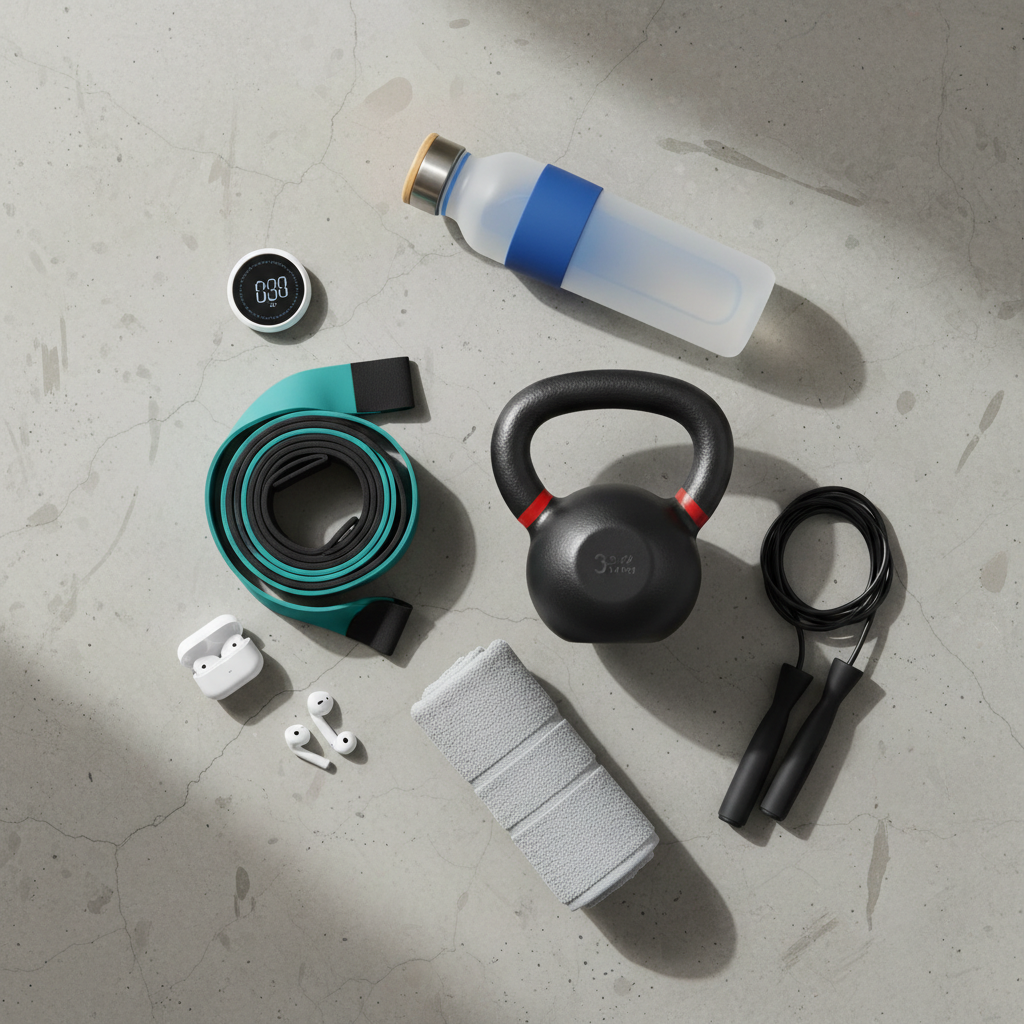
An effective workout plan can be built with a variety of tools. The best equipment is what you have access to and will use consistently.
| Equipment | Cost | Pro | Con |
|---|---|---|---|
| Barbells & Plates | High | Infinitely loadable, the gold standard for strength building. | Requires significant space and investment. |
| Dumbbells | Moderate-High | Versatile, promotes stability, allows for unilateral work. | Can become cumbersome and expensive at heavier weights. |
| Kettlebells | Moderate | Excellent for ballistic movements, conditioning, and grip strength. | Can have a steeper learning curve for complex movements. |
| Resistance Bands | Low | Portable, cheap, great for accommodating resistance and warm-ups. | Limited in providing top-end load for heavy compound lifts. |
| Bodyweight | Free | Accessible anywhere, builds incredible relative strength and control. | Difficult to progressively overload beyond a certain point. |

Seeing proper form in action is invaluable. These video playlists will help you master the techniques behind the key exercises in any great workout plan.
FAQ
Q: How long should my workout sessions be?
A - for most people, 45-75 minutes of focused training is the sweet spot. This is enough time to adequately warm up, perform your main work with sufficient intensity and volume, and cool down without spending hours in the gym. Quality over quantity is key.
Q: Should I do cardio before or after weights?
A - for most goals related to strength and muscle gain, perform cardio after your weight training session. Doing intense cardio first can fatigue your muscles and nervous system, compromising your ability to lift heavy and with good form. If cardio is your main priority, you can do it first or on a separate day.
Q: How do I know when to increase the weight?
A - use the double progression method mentioned earlier. When you can comfortably complete all your prescribed sets at the top of your target rep range (e.g., 3 sets of 10 reps) with perfect form, it's time to increase the weight by the smallest available increment in your next session.
Q: What's better: a full-body routine or a split routine?
A - it depends on your experience and schedule. Beginners benefit immensely from 2-3 full-body sessions per week to master movements and build a base. Intermediates and advanced trainees often need the increased volume and focus of a split routine (like Upper/Lower or PPL) to continue making progress.
Q: How often should I change my workout plan?
A - don't change it too often. Stick with a well-designed program for at least 8-12 weeks to allow for neurological and muscular adaptations. After that period, you can introduce a new plan or variation (a "mesocycle") to provide a new stimulus and prevent plateaus.
Q: Is it okay to work out if I'm sore?
A - it depends on the level of soreness. Mild to moderate delayed onset muscle soreness (DOMS) is normal, and light activity can actually help by increasing blood flow. If you are extremely sore to the point where it restricts your range of motion, it's better to take a rest day or train a different muscle group.
Q: Do I need to take supplements to get results?
A - no, supplements are not necessary, but they can be helpful. Think of them as the final 5% after you've already dialed in your training, nutrition, and sleep (the other 95%). A quality protein powder can be a convenient way to meet your protein goals, and creatine monohydrate is one of the most well-researched supplements for improving strength and performance.
Bottom line
A well-structured workout plan is the single most powerful tool you have for achieving your fitness goals. It provides direction, ensures progress, and transforms your time in the gym from guesswork into a focused, effective pursuit of a stronger you. Stop wandering and start training with purpose. Let Fullbody AI take the complexity out of the equation-our app will build you a personalized, intelligent plan that adapts and grows with you, every step of the way.