So, You're Getting Stronger... But Your Muscles Aren't Bigger?
You've been hitting the gym consistently for a few weeks. You're adding weight to the bar, reps to your sets, and that 20kg dumbbell suddenly feels... manageable. But when you look in the mirror, you don't really see a difference. What gives?
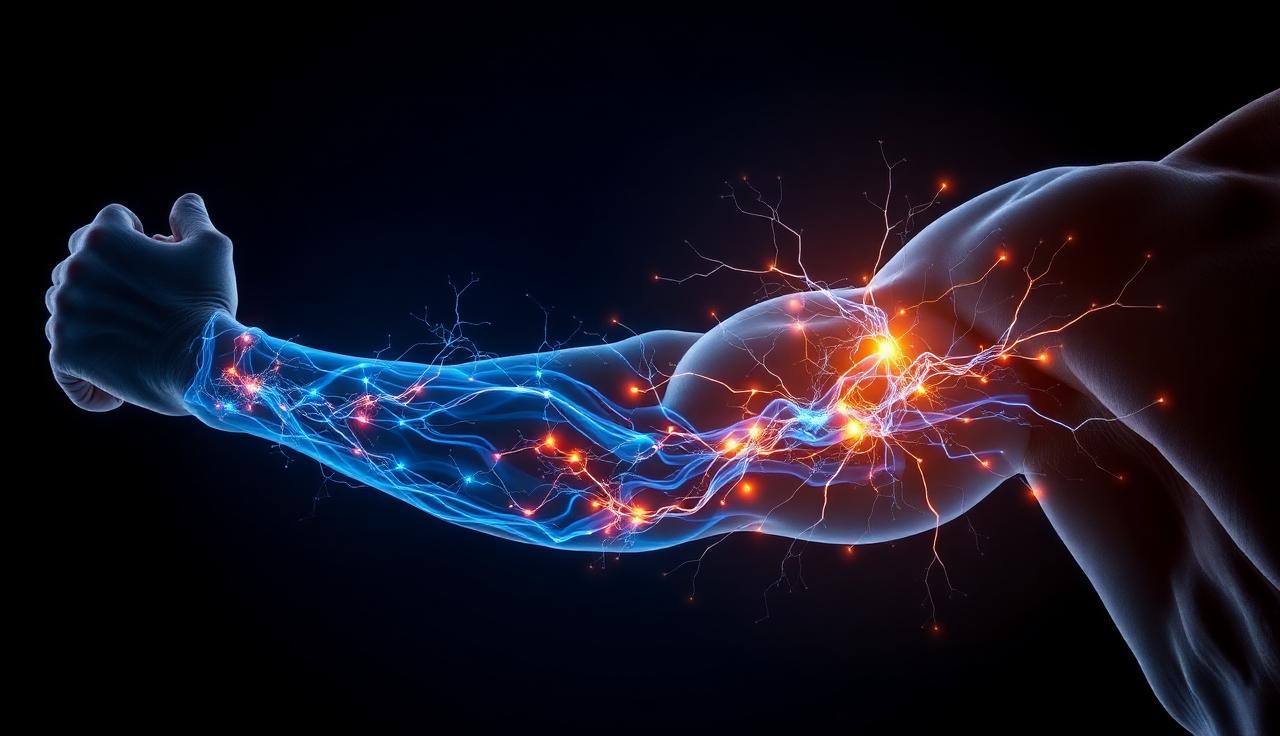
First off, congrats on the progress! Second, don't worry. This is totally normal. What you're experiencing is the first, and arguably coolest, phase of strength gain science: neural adaptations.
It's the "secret" reason you can get significantly stronger long before your muscles start to visibly grow (a process called hypertrophy). It’s not just about the size of the engine, but how well the driver-your brain-can use it.
Your Brain is the Real MVP
Let's be real, we all love to focus on the muscles. Biceps, glutes, quads-they're the stars of the show. But your central nervous system (CNS) - your brain and spinal cord - is the director calling all the shots.
Neural adaptation is simply your nervous system getting smarter and more efficient at commanding your muscles to contract. Think of it like learning any new skill, whether it's playing the guitar or learning to type. At first, you're clumsy, slow, and uncoordinated. But with practice, the movements become smooth, fast, and automatic.
The same thing happens when you lift weights. Your brain is learning the skill of generating force.
The How-To: A Peek Under the Hood
So how do muscles get stronger on a neural level? It boils down to a few key improvements. This is where the muscle adaptation explained part gets really interesting.
- •Better Motor Unit Recruitment - a motor unit is a single nerve and all the muscle fibers it controls. When you first start lifting, your brain is a bit hesitant. It only "recruits" a small number of motor units to do the job. With training, your brain gets more confident and learns to fire up more motor units simultaneously. It’s like going from a 4-cylinder engine to an 8-cylinder-you've got more power on demand.
- •Faster Rate Coding - this is all about the speed and frequency of the signals your brain sends to those motor units. A trained nervous system can send signals faster, telling the muscles to contract more forcefully and rapidly. It's the difference between a polite request and an urgent command.
- •Improved Coordination - this is twofold. You have intra-muscular coordination (how well fibers within a single muscle work together) and inter-muscular coordination (how well different muscle groups cooperate). Your body learns to fire the primary muscles for the lift (agonists) while relaxing the opposing muscles (antagonists). For a bicep curl, your brain gets better at firing your biceps while telling your triceps to chill out. Less internal resistance means a more efficient, stronger lift.
This whole process is fascinating, and experts have been studying neural adaptations strength for decades. Research published in the European Journal of Applied Physiology confirms these adaptations are the primary driver of initial strength gains.
Okay, Cool. How Do I Use This?
Understanding the science is great, but how does it help you in the gym tomorrow? Here’s the actionable part.
- Prioritize Technique. This is number one, non-negotiable. Lifting with sloppy form teaches your brain bad habits. Lifting with crisp, consistent technique builds efficient neural pathways. This is the foundation of long-term strength. You're literally programming your nervous system for success.
- Be Consistent. Your brain learns through repetition. Skipping workouts or being inconsistent means your CNS doesn't get the practice it needs to refine those motor patterns. This is where an app like FullBody AI can be a game-changer. It provides a structured plan and progressive overload, ensuring you’re consistently giving your nervous system the right stimulus to adapt.
- Lift with Intent. Don't just go through the motions. When you're lifting, especially on your heavy sets, focus on moving the weight as powerfully and quickly as you can (while maintaining perfect form, of course). This conscious effort to be explosive directly trains rate coding and motor unit recruitment.
So, the next time you hit a new personal best, give a little nod not just to your muscles, but to your brain. It’s working just as hard to make you a stronger, more capable human. Strength is a skill, and you’re getting better at it with every single rep. 💪